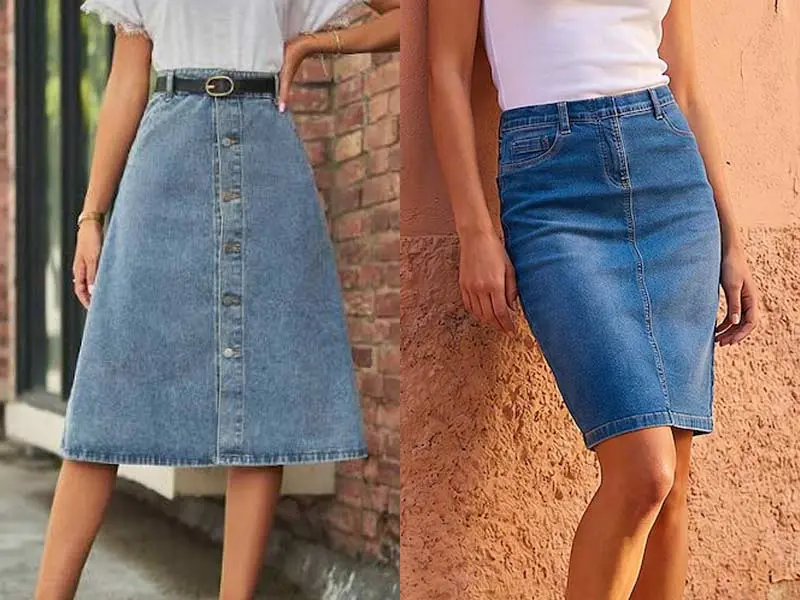
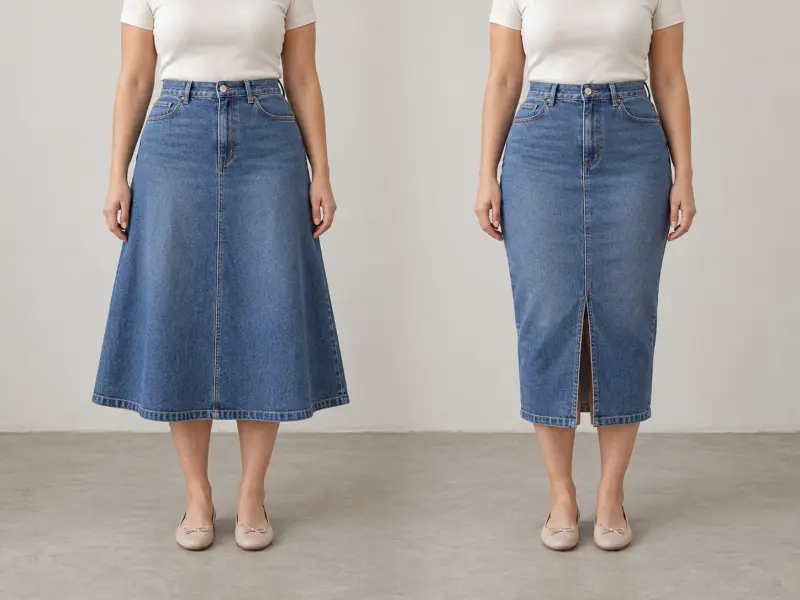
Two denim skirts can use the same blue shade, similar pocket details, and almost identical hardware, yet feel like completely different products the moment someone walks in them. The reason is silhouette. An A-line skirt creates controlled space as it travels from the waist toward the hem, while a pencil skirt keeps that space much closer to the body. That single design decision influences comfort, body proportion, fabric weight, stretch requirements, slit construction, pocket placement, grading, wash behavior, and even how easily the approved sample can be reproduced in bulk. For anyone comparing these styles, the useful question is not simply which one looks better in a product photo. The better question is which silhouette supports the intended wearer, fabric, length, styling direction, and level of movement without creating new fit problems elsewhere.
An A-line denim skirt is usually the more forgiving option for movement because it stays defined at the waist while releasing volume toward the hem. A pencil denim skirt creates a closer, more elongated shape and generally needs more precise waist-to-hip engineering, carefully chosen fabric, and enough room for walking. Neither silhouette is universally better. The right choice depends on desired shape, fabric structure, stretch and recovery, skirt length, slit design, wash behavior, and the fit expectations of the intended customer.
A useful comparison often appears during sampling rather than on a mood board. A designer may begin with a clean pencil reference, but the first washed sample rides upward after several steps. Another team may start with a structured A-line, only to find that a heavy denim makes the skirt stand too far away from the body. Small changes to hem sweep, fabric weight, slit length, or side-seam balance can transform the result. Understanding those relationships is what turns a silhouette name into a product that looks right, moves naturally, and still holds its identity after washing and repeated wear.
What Is the Difference Between an A-Line and Pencil Denim Skirt?
An A-line denim skirt fits relatively close at the waist and upper hip before widening toward the hem, while a pencil denim skirt follows the waist, hip, and lower body more closely. The difference affects far more than appearance: A-line styles usually gain movement from wider hem sweep, while pencil styles depend more on precise fit, fabric extension, slit design, and post-wash dimensional control.
What Defines an A-Line Denim Skirt?
A proper A-line skirt is defined by controlled release rather than by a simply wide hem. The waist and upper hip should still feel intentional, while additional circumference is introduced progressively farther down the body. If the release begins too high or becomes too aggressive, the skirt can look boxy and lose waist definition. If the release is too limited, the shape reads closer to a straight skirt. In denim, this balance is especially visible because the fabric has enough body to make small pattern changes noticeable.
Fabric structure determines how strongly that outline holds. A mid-weight rigid cotton denim can create a crisp, geometric A shape, while a softer or lighter fabric allows the same pattern to fall closer to the legs. This makes fabric selection part of silhouette development rather than a later styling choice. The designer also has more freedom with patch pockets, raw hems, panels, or utility details because the garment already contains extra lower-body volume, but that freedom still requires control. Side seams should remain visually balanced, the hem should hang evenly, and wash shrinkage should not turn a clean A-line into a twisted or uneven skirt.
What Defines a Pencil Denim Skirt?
A pencil denim skirt is designed to remain closer to the body from the waist through the hip and usually into the lower skirt. The line may be almost straight below the hip or slightly tapered, but the key idea is controlled volume. Because the fabric stays nearer to the body, fit errors become easier to see and feel. Horizontal drag lines, a gaping back waist, a side seam pulling forward, or a skirt that climbs when walking often indicate that the pattern, fabric, or front-to-back balance needs correction rather than simply a larger size.
Rigid denim can produce a very clean pencil silhouette, but it requires enough real ease for sitting and walking because the fabric contributes little extension. Stretch denim can support a closer fit, yet stretch alone is not the goal. Recovery matters just as much. A fabric that extends easily but does not return well can leave the seat or waistband loose after wear. Length also changes the engineering challenge: a short pencil skirt may function without a slit, while a midi or maxi version often needs more hem room, controlled stretch, a slit, or a combination of those features to avoid restricted movement.
How Do Their Silhouettes Compare?
The most useful way to compare A-line and pencil skirts is to examine where each design allows volume. An A-line keeps the waist controlled but gradually moves away from the thighs, so the garment creates its own movement space. A pencil silhouette keeps the lower circumference tighter, which makes the wearer more dependent on accurate hip ease, hem opening, stretch behavior, and slit construction. This is why a pencil skirt can look simple on a sketch while requiring more technical fitting work than a visually fuller A-line style.
| Fit Point | A-Line Denim Skirt | Pencil Denim Skirt |
| Waist | Defined and stable | Precise and fit-sensitive |
| Full hip | Skims or follows moderately | Follows more closely |
| Lower body | Increasing ease | Controlled ease |
| Hem circumference | Wider | Narrower |
| Slit need | Usually low to moderate | Often higher at midi/maxi length |
| Stretch dependence | Usually lower | Often higher |
| Main fit risk | Excess bulk or uneven flare | Restriction, drag lines, riding up |
| Wash sensitivity | Hem balance and twist | Waist, hip, recovery, mobility |
The JEANZIO product framework treats A-line and pencil skirts as distinct members of the women’s denim-skirt category and places particular attention on waist-to-hip fit, slit construction, front and back balance, walking room, and post-wash stability. That approach reflects an important production reality: silhouette is not a single measurement. A change in hem width can alter movement, a change in fabric can alter drape, and a wash process can alter both dimensions and handfeel. The best comparison therefore considers the finished garment as a system rather than labeling one style as simply loose and the other as simply tight.
Which Denim Skirt Works Better for Different Body Shapes?
A-line skirts generally create more visual space below the hip and can emphasize the waist without tracing the thigh closely, while pencil skirts follow existing curves more directly. Neither shape is automatically more flattering for every person. The better choice depends on waist-to-hip proportion, preferred curve definition, rise, skirt length, pocket placement, fabric structure, and the amount of movement the wearer expects from the garment.
Which Shape Creates More Waist-to-Hip Balance?
A-line skirts are often chosen when the design goal is to define the waist while allowing the lower body to feel less constrained. Because the side line gradually moves outward, the garment transitions from a narrower waist to a broader hem rather than following the thigh closely. This can make the waist appear more pronounced and soften emphasis on the full hip. The effect still depends on where the flare begins: too much release near the waist reduces definition, while too little below the hip can make the skirt look almost straight.
The amount of flare also needs to match fabric and length. A short A-line in firm denim can look sharp with relatively modest hem sweep, while a midi version may need more careful shaping so the added length does not feel stiff. Large patch pockets, a deep yoke, contrasting wash zones, or heavy topstitching can also change perceived width. For product development, waist, high hip, full hip, hem sweep, and finished length should be reviewed together. This produces a more reliable result than trying to assign a single silhouette to a broad body-shape label without considering the actual garment proportions.
Which Shape Emphasizes Curves More?
Pencil skirts usually emphasize curves more strongly because the pattern remains close to the waist, hip, and upper leg instead of releasing substantial volume below. This can create a clean, elongated line, but the closer fit also exposes inaccuracies that an A-line may visually hide. If the front hip is short on room, horizontal tension lines appear. If the back waist shape is not controlled, the waistband can stand away from the body. If the side seam moves forward, the front-to-back distribution may be wrong even when the total hip measurement looks correct on paper.
Stretch denim often helps a fitted silhouette move more comfortably, but the material should be judged by recovery as well as extension. A fabric can contain elastane and still relax more than expected after sitting or repeated wear. In development, it is useful to review the garment after washing and again after movement rather than approving it only on a standing fit model. The aim is not to make the skirt as tight as possible; the aim is to create a close line that still returns to shape and keeps its waistband, pocket area, and side seams stable during normal use.
Which Style Works Better at Different Lengths?
Length changes the behavior of both silhouettes. A mini A-line usually needs less dramatic flare because the legs are already free below the hem, while a midi A-line needs enough sweep to move naturally without looking excessively triangular. A maxi A-line introduces additional fabric weight, so side-seam balance, drape, twisting, and hem stability become more important. The longer the garment, the more visible any unevenness becomes because the eye follows a longer continuous line from the waist to the floor area.
Pencil skirts become more demanding as they become longer. Above-knee versions may rely mainly on good hip fit and appropriate lower circumference. Knee and midi lengths introduce more direct stride restriction, while maxi pencil styles can require a larger slit, more flexible fabric, or a less aggressive taper. A useful fit review asks where the hem sits relative to the knee and calf, how far the wearer can step comfortably, and whether the garment rises during motion. Those practical checks provide more useful information than choosing length based only on a front-view photograph.
Which Denim Skirt Offers Better Comfort and Movement?
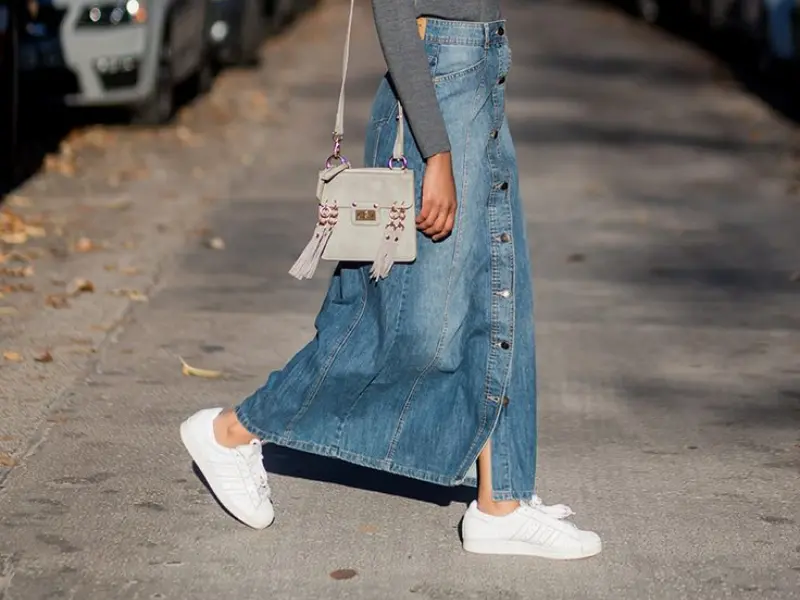
A-line denim skirts usually provide easier natural movement because the hem circumference increases below the hip, creating physical room for the legs. Pencil skirts can still be very comfortable, but their comfort depends more on hip and lower-body ease, fabric extension, recovery, slit design, and finished length. The narrower and longer the pencil silhouette becomes, the more deliberately movement must be engineered into the product.
How Does Hem Width Affect Movement?
Hem circumference is one of the most practical measurements in a skirt, yet it is often overshadowed by waist and hip figures. A garment may fit beautifully around the torso but still feel frustrating if the lower opening does not accommodate a normal stride. An A-line generally avoids this problem because the pattern creates extra circumference as it moves downward. Even rigid denim can remain easy to wear when the hem sweep gives the legs enough room, which is one reason structured cotton fabrics pair naturally with many A-line shapes.
A pencil skirt reaches its mechanical limit sooner. When the wearer takes a long step, climbs stairs, gets into a car, or sits with the knees apart, the lower garment needs additional effective circumference. If the hem is too narrow, the skirt may ride upward, rotate, pull across the hip, or force a shorter stride. Standing fit alone therefore gives an incomplete picture. During sampling, walking, sitting, stepping, and repeated movement should be included in the fit review. Hem width is not just an aesthetic measurement; at midi and maxi lengths, it becomes a functional performance measurement.
Do Pencil Denim Skirts Need a Slit?
Not every pencil denim skirt needs a slit, but the need grows as length increases, hem circumference decreases, or the fabric becomes less flexible. The slit temporarily increases effective movement without permanently widening the entire lower silhouette. A back slit usually produces a quieter, tailored appearance, while a front slit becomes a stronger design feature and can visually lengthen the center line. Side slits suit certain asymmetric or fashion-led constructions, but the best placement depends on both styling and the stress path created during walking.
Three measurements should be considered together: finished skirt length, hem circumference, and usable slit opening. A high slit cannot fully compensate for a hip that is too tight, and a short slit on a rigid midi skirt may provide only limited improvement. The top of the slit also becomes a repeated stress point, so reinforcement, seam construction, and bulk consistency matter. A successful slit should open naturally during movement, remain flat when the wearer is standing, and return to its intended position without twisting the skirt or creating excessive tension at the termination point.
How Do Rise and Hip Ease Affect Comfort?
Rise determines where the waistband sits and therefore changes how the pattern travels from the waist into the full hip. A high-rise skirt begins at a relatively narrow part of the torso and must transition through a larger difference between waist and hip circumference. If that transition is too aggressive, the wearer may feel pressure at the waist or upper hip. A mid-rise places the waistband closer to the high hip and changes the amount and distribution of shaping, while lower rises introduce their own stability and sitting considerations.
Fabric behavior determines how much of the comfort must come from pattern ease. Rigid denim depends primarily on actual garment dimensions, while stretch denim can contribute controlled extension. The mistake is using stretch to rescue an undersized pattern. That often produces excessive tension, poor recovery, or a waistband that changes shape after wear. Useful checkpoints include waist, high hip, full hip, lower hip or thigh, hem, slit length, and finished garment length. These points should be reviewed after the intended wash because denim can change in both measurement and handfeel during finishing.
Which Denim Fabric Works Best for Each Silhouette?
Structured rigid denim often suits A-line skirts because it helps hold a clear outward shape, while comfort-stretch denim often works well for pencil skirts because it supports close fitting and movement. The best fabric cannot be selected by fiber content alone. Weight, drape, extension, recovery, shrinkage, surface character, and wash response all influence whether the finished skirt keeps its intended silhouette after processing and wear.
Is Rigid Denim Better for A-Line Skirts?
Rigid denim is a strong starting point for an A-line when the design needs a crisp, vintage, utility, or structured look. Cotton-rich fabrics hold the flare clearly, keep panel lines visible, and develop attractive abrasion around seams and edges. The risk appears when structure becomes excessive. A heavy fabric combined with a wide mini flare can stand away from the legs more than expected, while a long A-line in very firm denim can feel cumbersome because the fabric mass grows with length and sweep.
A useful approach is to choose weight according to silhouette rather than season alone. JEANZIO’s internal fabric framework uses approximately 8-9.5 oz for lighter warm-weather products, 9.5-11 oz as a broadly useful cross-season range, 11-12 oz for more substantial garments, and 12-13 oz for stronger structure or heavier vintage direction. These are practical development ranges, not fixed rules. Yarn construction, finishing, density, and washing can make two fabrics at the same nominal weight feel very different, so physical sampling remains more reliable than selecting fabric from weight data alone.
Does Stretch Denim Work Better for Pencil Skirts?
Stretch denim is often practical for pencil skirts because the fabric can extend while the wearer sits, walks, or bends, reducing the amount of mobility that must come from pattern ease alone. That does not mean the highest stretch level is automatically the best choice. A close skirt needs enough extension for comfort and enough recovery to return toward its approved dimensions. If recovery is weak, the seat can relax, the waistband can grow, and the lower garment can lose the controlled line that made the pencil silhouette attractive in the first place.
The development sequence should therefore test the actual fabric rather than rely only on the fiber label. First review extension and handfeel, then develop the pattern around that behavior, wash the sample using the intended process, measure it again, and reassess shape after movement. Changing fabric after fit approval is especially risky in a pencil skirt because the pattern is closely tied to material behavior. High stretch can also soften the traditional denim character, so many commercial products benefit from moderate stretch with good recovery rather than maximizing elasticity without considering long-term shape retention.
How Do Denim Weight and Drape Change the Shape?
Weight and drape determine whether the skirt stands away from the body or falls toward it. A structured 10 oz denim can create a clean A-line with visible flare, while another 10 oz fabric with a softer finish may hang much closer to the legs. Lightweight denim can create attractive movement, but it may reveal seam puckering, pocket outlines, or internal construction more easily. Heavy denim can hide some surface irregularity but exaggerate seam bulk and make wide silhouettes feel more rigid.
| Denim Weight | Typical Direction | A-Line Use | Pencil Use |
| 8-9.5 oz | Light and fluid | Soft mini/midi, warmer climates | Light fitted styles with stability checks |
| 9.5-11 oz | Cross-season core | Highly versatile | Strong option with suitable ease or stretch |
| 11-12 oz | More substantial | Structured A-line, vintage character | Rigid pencil needs careful mobility control |
| 12-13 oz | Heavy and structured | Strong utility or statement shape | Usually demanding for close, long silhouettes |
Wash compatibility belongs in the same decision. Rigid cotton generally handles vintage fading and structured abrasion well, while highly elastic fabrics require more cautious washing to protect recovery. Lightweight fabrics benefit from gentler mechanical treatment because aggressive processing can increase distortion or seam instability. A useful design process therefore starts with the target silhouette, then defines the fabric performance window, and only after that chooses wash intensity. Selecting a visually attractive fabric first and forcing it into the wrong silhouette often creates avoidable fitting and production problems later.
How Do Pattern and Construction Affect Denim Skirt Fit?
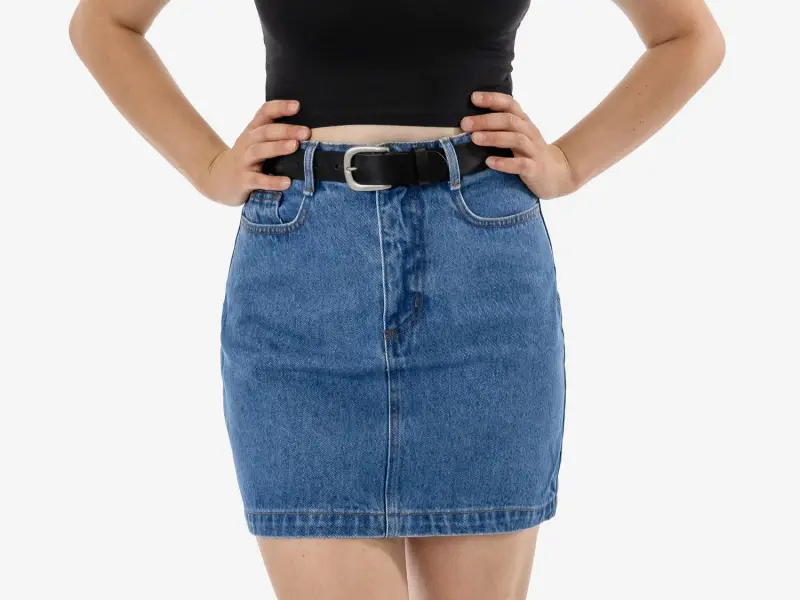
Pattern engineering determines whether the intended A-line or pencil silhouette actually survives sewing, washing, grading, and normal wear. Waist-to-hip shaping, side-seam balance, darts, panels, pockets, slit position, hem sweep, and grading all influence the result. In denim, these decisions must also anticipate fabric rigidity, shrinkage, seam bulk, and wash behavior, so a successful pattern controls both appearance while standing and performance during movement.
How Is Waist-to-Hip Fit Engineered?
Waist and hip measurements are connected through a three-dimensional shape, not a simple straight line. An A-line skirt can release room shortly below the hip, giving the pattern maker more freedom in the upper body. A pencil skirt follows the body farther down, so each reduction and release becomes more visible. Shaping may come from side seams, darts, yokes, curved waistbands, vertical panels, or a combination of these methods.
Where shaping is placed can matter as much as the total amount removed. Too much side-seam suppression can distort the line, deep darts can create points, and insufficient back shaping can cause waistband gaping even when total waist circumference is correct. Front-to-back distribution also matters because two people with the same full hip measurement can carry volume differently. Development should start with a defined base size, target measurements, intended rise, and fit reference, then use fitting feedback to refine balance.
How Do Seams and Panels Change the Shape?
Seams are structural tools as well as visual details. A center-front seam can support a slit, divide a broad denim surface, and provide another line for controlling shape. Vertical panels can distribute flare more evenly in an A-line or contouring more precisely in a pencil skirt. This can reduce reliance on deep darts or aggressively curved side seams and improve the visual transition from waist to hem when the panel design is planned from the beginning.
Every added seam also introduces a production variable. Stitch tension, seam allowance, topstitching, bulk, and wash abrasion must remain consistent. Rigid denim can build thickness at intersections, while lightweight denim can ripple if tension is wrong. Raised seam edges also tend to show stronger wash abrasion. Each seam should therefore contribute to shape, function, or identity; otherwise it may add cost and another opportunity for variation without improving the product or its long-term consistency.
Do Pockets and Slits Affect the Silhouette?
Pockets influence both proportion and physical behavior. Large patch pockets can make the hip appear wider and add a fabric layer that changes how the surface lies. On a close pencil skirt, a pocket opening can flare or pull when the underlying area is under tension. An A-line usually tolerates utility pockets more easily, but pocket weight and position can still disturb the fall of the skirt when they are oversized or placed too low.
Slits play a stronger functional role because they directly influence movement. Front slits create a visible vertical line, back slits are quieter, and side slits suit more directional designs. Key controls include slit length, usable opening, reinforcement position, and lower circumference when closed. In JEANZIO’s denim-skirt framework, slits, panels, pockets, raw hems, and wash differences are treated as variables that can change fit and sewing stability, not as decoration alone in the final finished garment.
How Does Pattern Grading Protect the Silhouette?
A strong base-size sample does not guarantee a strong size range. During grading, waist, hip, length, darts, pocket position, slit length, and hem circumference all change. Those changes should preserve the original visual intent rather than enlarge every measurement proportionally. Pencil skirts are especially sensitive: insufficient hem growth can make larger sizes restrictive, while excessive uniform growth can turn the silhouette into a straighter skirt and weaken its controlled line.
A-line skirts face the opposite risk. Too much hem growth can make larger sizes look more flared than the approved base size, while too little can flatten the silhouette. Extended sizing should consider waist-to-hip relationships, rise, ease distribution, and body proportion instead of simple proportional enlargement. Size-set fitting is a practical way to catch these issues before bulk production, particularly for close pencil shapes, long hemlines, rigid fabrics, and broader size ranges where proportion changes matter more across the full size run.
How Do Wash and Shrinkage Change the Final Fit?
Denim washing can change garment dimensions, handfeel, drape, color, and surface character, so the finished fit should be evaluated after the intended wash rather than from an unwashed sewing sample alone. A skirt can fit correctly before washing and still become shorter, tighter, softer, more twisted, or less stable afterward. Pattern compensation, wash approval, shade control, and post-wash measurement therefore belong to the same fit-development process.

How Does Denim Washing Affect Silhouette?
Washing can change the shape of an A-line and a pencil skirt in different ways. A structured A-line may soften after enzyme, stone, or softening treatments and fall closer to the body, reducing the crispness that was visible in the raw sample. That can be desirable for a casual vintage look, but it becomes a problem if the approved design depends on a strong outward line. The effect is even more noticeable in longer A-line skirts because the larger fabric area makes changes in drape easier to see.
A pencil skirt may become more comfortable after softening, yet aggressive washing can also reduce recovery, change waist and hip dimensions, or increase seam distortion. Wash appearance alters perceived proportion as well. Heavy fading around the hip can make that area more visually prominent, while darker side zones can create a narrower effect. Raised seams can become stronger visual lines after abrasion. Wash approval should therefore assess color, surface effect, finished dimensions, drape, and movement together rather than treating shade match as the only criterion for a successful sample.
How Is Shrinkage Allowed for in the Pattern?
Shrinkage is most effectively controlled before bulk cutting. Denim can change in both warp and weft directions during washing, and different fabric lots or wash recipes may not behave identically. The pattern used for cutting therefore may need compensation so that the finished garment reaches the approved measurements after processing. That compensation should come from actual fabric and sample evidence rather than a generic percentage applied to every style, because a fitted pencil and a wide A-line do not react to dimensional change in the same way.
A practical sequence begins with target finished measurements, then reviews fabric shrinkage, develops the pattern with preliminary allowance, produces and washes the sample, measures the finished garment, and corrects the pattern or wash route where necessary. Once the combination is stable, the approved pattern and wash reference can be frozen for bulk. JEANZIO’s manufacturing framework links fabric shrinkage, pattern compensation, wash samples, PP approval, and bulk measurement as connected control points. That sequence is especially valuable for pencil skirts, where a small change around the hip or hem can quickly affect comfort and movement.
How Is Fit Controlled from Sample to Bulk?
Bulk consistency depends on production teams using the same approved references. The pattern, measurement specification, fabric, trims, workmanship standard, wash sample, and any shade reference need to point to one current version. If one element changes while the rest remain old, the risk of drift rises quickly. The first bulk wash is particularly important because it tests whether the approved development result can be reproduced under production conditions rather than only in a sample-room environment.
| Production Stage | Main Control | A-Line Risk | Pencil Risk |
| Fabric inspection | Lot, shade, weight, shrinkage | Drape change | Stretch/recovery change |
| Cutting | Grain, direction, panel accuracy | Uneven flare | Fit imbalance |
| Sewing | Seam shape, symmetry, tension | Twisted side line | Drag lines, tight areas |
| Pre-wash | Construction completeness | Hem inconsistency | Slit or zipper issue |
| First bulk wash | Shade, shrinkage, handfeel | Loss of structure | Tightness or recovery loss |
| Post-wash measure | Waist, hip, length, hem | Twist or uneven hem | Critical fit deviation |
| Final inspection | Appearance and workmanship | Flare consistency | Distortion or riding tendency |
JEANZIO’s documented quality flow includes material inspection, cut-panel checks, inline sewing control, pre-wash review, first-bulk and post-wash assessment, 100% finished-garment inspection, final AQL 2.5 or customer-defined inspection, and packing checks. For a denim skirt, those checkpoints are most useful when they are tied to style-specific risks instead of treated as a generic checklist. An A-line needs particular attention to hem balance and twist, while a pencil needs closer control of hip measurements, lower circumference, slit position, stretch recovery, and any fit distortion created after washing.
Which Denim Skirt Should Brands Develop?
Brands should choose an A-line when the product needs easier movement, visible waist definition, greater compatibility with rigid denim, and a more open lower silhouette. A pencil skirt is stronger when the concept depends on a clean, close, or body-conscious line. The commercial choice should combine target customer, fabric, length, wash, fit risk, styling direction, and expected wear situation rather than following a silhouette trend in isolation.
Which Style Fits a Casual Collection?
A-line skirts offer broad flexibility for casual collections because the silhouette works naturally with classic indigo, vintage washes, black denim, raw hems, utility pockets, panel seams, and mini or midi lengths. Rigid or low-stretch denim is easier to use because movement comes partly from garment geometry rather than fabric extension. This can preserve an authentic denim character while still giving the wearer practical room for walking, sitting, and everyday movement across a broad casual-wear program.
One successful A-line block can support several related SKUs when fit-sensitive variables are controlled. A new wash may change shrinkage and softness, a heavier fabric may change drape, and a large patch pocket may alter the visual hip line. The efficient approach is to identify which parameters can safely carry over from the approved style and which changes require another sample or measurement review before launch. This keeps related SKUs visually connected without assuming identical technical behavior.
Which Style Fits a More Fitted Collection?
Pencil denim skirts work well when a collection needs polished lines, stronger curve definition, or a body-conscious silhouette. Dark indigo, black, clean rinses, or controlled vintage washes suit this direction because they keep the silhouette and seam placement visually clear. Front slits, exposed zippers, asymmetric closures, or vertical panels can add fashion interest without widening the shape, provided the construction does not create excessive bulk in a close-fitting area.
The technical requirement is to define what fitted means for the intended wearer. A work-oriented pencil midi should prioritize sitting comfort, walking room, and recovery, while a fashion-led style may use closer ease and more stretch. These products should not share the same fit assumptions simply because both are pencil skirts. Fabric specification, base-size measurements, slit dimensions, fitting comments, and wash process should all reflect the desired wearing experience and preserve the intended line through real movement, sitting, and repeated wear.
How Should Brands Choose Between A-Line and Pencil?
The decision becomes clearer when the product team starts with the intended wearing experience. If the style should feel easy, structured, vintage, utility-led, or suitable for rigid denim, an A-line is often the more forgiving base. If the concept depends on a polished, narrow, or curve-focused shape, pencil is usually the stronger starting point. Length then changes the answer because a long pencil needs more deliberate mobility engineering than an equally long A-line.
Useful selection questions include whether the garment should stand away from the body or follow it, whether rigid denim is essential, how much walking freedom is expected, whether a visible slit is acceptable, and how the style should behave across sizes. Sometimes the best commercial result sits between textbook silhouettes. A soft A-line may use modest hem expansion, while a pencil may become almost straight below the hip to improve wearability without losing its visual direction or intended proportion.
How Can Sampling Confirm the Right Choice?
Sampling turns a silhouette idea into measurable evidence. A reference image can show proportion, wash direction, and mood, but it rarely contains enough information about finished measurements, internal construction, fabric extension, recovery, or shrinkage. A practical sequence moves from reference or Tech Pack to fabric selection, pattern, first sample, fit review, wash sample, revision, PP approval, and bulk production. Skipping stages often transfers unresolved fit or wash problems into production.
JEANZIO’s documented process places a typical first sample at approximately 7-15 days and revision or PP samples at around 7-10 days, depending on fabric availability, wash complexity, and design changes. Before bulk, the approved sample, pattern version, measurements, fabric, trims, wash standard, shade range, and workmanship requirements should align. For an A-line versus pencil decision, the most reliable approval comes after the correct fabric has been washed and fitted on the body, where small changes in sweep or stretch become obvious.
Conclusion
A-line and pencil denim skirts are not competing answers to the same design problem. They solve different ones. The A-line uses controlled lower-body volume to create movement, waist emphasis, and flexibility with structured fabrics. The pencil uses closer shaping to create a cleaner, more fitted line, which makes fabric recovery, hip ease, slit design, grading, and wash control more important. The best product decision comes from connecting silhouette with actual wear, not from choosing a trend name before the technical work begins. When fabric, pattern, washing, and movement are developed together, both shapes can become dependable commercial styles rather than samples that only look convincing while standing still.
For brands developing a denim skirt collection, the most useful starting information is usually straightforward: a reference image or Tech Pack, intended base size, target length, preferred wash, fabric direction, size range, and the desired level of fittedness. From there, pattern and sample development can reveal whether the original concept should remain a clear A-line, become a softer version, stay pencil-shaped, or move toward a straighter compromise. That process creates a product that is easier to approve, easier to reproduce, and more likely to satisfy the person who eventually wears it.
FAQ: Is an A-Line Denim Skirt More Comfortable Than a Pencil Skirt?
In many cases, yes, because an A-line skirt naturally creates more circumference below the hip and therefore gives the legs more room during walking and sitting. That does not mean every A-line is automatically comfortable. A very stiff fabric, tight waist, or poorly balanced pattern can still cause problems. Pencil skirts can also be comfortable when hip ease, hem opening, stretch, recovery, and slit design are coordinated correctly. Comfort comes from the whole garment system rather than from silhouette name alone.
FAQ: Is Rigid Denim Suitable for a Pencil Skirt?
Rigid denim can work well for a pencil skirt when the design aims for a structured, authentic denim look, but the pattern must provide enough physical room because the fabric contributes little stretch. Shorter lengths are generally easier to manage, while midi or maxi rigid pencil skirts often need a slit, a slightly straighter lower shape, or more hem circumference. Sampling should include walking and sitting because a rigid skirt that looks clean while standing can become restrictive as soon as the wearer moves.
FAQ: What Denim Weight Is Best for an A-Line Skirt?
There is no single ideal weight, but approximately 8-9.5 oz works well for softer or warmer-weather A-line styles, 9.5-11 oz is a versatile cross-season range, and 11-12 oz can support a more structured or vintage silhouette. Heavier 12-13 oz denim can create a strong statement shape but may feel bulky in wide or long skirts. The final choice should also consider finishing and wash because fabric of the same nominal weight can feel very different after softening, enzyme treatment, or mechanical abrasion.
FAQ: Do Midi Pencil Denim Skirts Need a Front or Back Slit?
Many midi pencil skirts benefit from a slit because the hem sits low enough on the leg to restrict stride when the lower circumference is narrow. A front slit makes the feature more visible and can become part of the design, while a back slit gives a quieter, more tailored appearance. The correct length depends on skirt length, hem width, fabric stretch, and intended movement. A slit should improve mobility without becoming so high that it changes coverage or creates instability at the seam opening.
FAQ: How Does Denim Washing Affect Skirt Fit?
Washing can change length, waist and hip measurements, softness, drape, color, stretch recovery, and seam behavior. A structured A-line may become softer and lose some visual flare, while a fitted pencil may become tighter after shrinkage or looser over time if elastic recovery is damaged. For that reason, fit approval should be based on the intended washed sample rather than only on an unwashed garment. Post-wash measurement, shade review, and movement fitting are practical ways to confirm that the final product still matches the design target.
FAQ: Can an A-Line and Pencil Skirt Use the Same Denim Fabric?
They can, but the same fabric will not necessarily produce equally successful results in both silhouettes. A structured rigid denim may create an excellent A-line but feel restrictive in a long pencil skirt. A soft stretch denim may make a pencil comfortable but cause an A-line to lose the crisp shape the designer expected. When one fabric is shared across a collection, each silhouette should still be sampled and washed separately so that pattern ease, hem shape, and finished measurements can be adjusted to the material’s actual behavior.
FAQ: What Should Be Approved Before Bulk Denim Skirt Production?
Before bulk production, the approved sample, current pattern, measurement specification, fabric, trims, wash standard, shade range, slit and pocket details, size range, workmanship requirements, labels, and packing instructions should all refer to the same confirmed version. For fitted or wash-sensitive skirts, post-wash measurements and size-set checks are particularly useful. A disciplined approval process reduces the risk of finding out too late that the bulk fabric, wash, or pattern behaves differently from the sample that originally received approval.