Skip to content
A beautifully washed denim sample can convince a fashion brand to place an order, but the quality of that sample does not automatically carry through to thousands of finished garments. A waistband may shrink more than expected, a washing batch may turn out noticeably darker, or a zipper may stop working after finishing. At Jeanzio, we regard the transition from an approved sample to a consistent bulk order as one of the most important challenges in denim manufacturing.
Final inspection for denim apparel is the last systematic assessment of finished denim garments before shipment. It checks measurements, fit, wash consistency, fabric appearance, stitching, hardware, labeling, and packaging against approved samples and technical specifications. Manufacturers can combine 100% finished garment screening with AQL acceptance sampling to identify nonconforming garments, assess production lot quality, and support an informed decision about whether to release the shipment.
Imagine opening a shipment of 5,000 jeans just before a seasonal launch and discovering that several cartons contain a different shade from the approved wash. Even if the seams and measurements are correct, those jeans may no longer fit the collection’s retail presentation. Understanding final inspection, from the first measurement check to the final acceptance decision, helps sourcing teams address these problems while the goods are still at the factory.
What Is Final Inspection in Denim Manufacturing?
Final inspection in denim manufacturing is a quality control stage conducted after garment assembly, washing, and finishing. Inspectors assess completed products against agreed appearance, measurement, construction, functional, and identification requirements. It identifies remaining nonconformities and provides evidence for shipment acceptance, while earlier production inspections address problems before they become widespread or difficult to correct. Packing verification may form part of the final inspection or take place separately.
What Is the Purpose of Final Inspection?
Final inspection protects the commercial value of finished denim garments by identifying unacceptable differences before products enter distribution. Denim presents particular challenges because washing, drying, distressing, and pressing can change a garment that was correctly assembled during sewing. A pair of jeans can meet its pre-wash dimensions but fall outside the finished size specification, while a carefully stitched jacket can develop unwanted abrasion during processing. The completed product, rather than an earlier unfinished version, must be the basis for judging finished garment conformity.
Consider a hypothetical order of 10,000 jeans at a manufacturing cost of $15 each. The total manufacturing value is $150,000. If 3% of the garments are nonconforming, 300 pieces representing $4,500 in manufacturing value may require attention. That figure is not an estimate of actual losses: it excludes freight, refunds, warehouse handling, and any recovery through rework. Resolving the affected garments before shipment generally leaves more practical options than discovering the same issue after distribution.
How Does Final Inspection Differ from Inline Inspection?
Inline inspection takes place during manufacturing, when problems can still be corrected before subsequent operations. Final inspection evaluates completed garments after the processes that establish their final appearance and dimensions. For example, a misplaced back pocket is much easier to reposition before washing. After washing, removing that pocket can expose darker fabric underneath or leave permanent needle marks. A late inspection may detect the defect, but the earlier checkpoint is what makes prevention and economical correction possible. A denim quality control process typically includes the following checkpoints, each addressing a different production risk:
- Incoming inspection: Fabric, shade groups, trims, and material specifications.
- Cut panel inspection: Cutting accuracy, fabric defects, and panel matching.
- Inline sewing inspection: Stitch formation, construction, and component placement.
- Pre-wash inspection: Assembly defects that would be difficult to repair later.
- Post-wash inspection: Shade, dimensions, processing damage, and wash effects.
- Final inspection: Conformity of finished garments with approved requirements.
- Packing inspection: Identification, assortments, quantities, and carton markings.
Is Final Inspection the Same as Pre-Shipment Inspection?
The terms are sometimes used interchangeably, but final inspection often focuses on finished garment conformity, whereas pre-shipment inspection may also address packed quantities, cartons, barcodes, assortment ratios, and shipment readiness. A factory can screen individual garments before packing and arrange a separate random inspection once the order reaches the agreed completion and packing status. Depending on the contract, the latter may be performed by factory quality staff, the customer’s representative, or an independent inspection company.
The distinction matters for a shipment containing four styles, three wash colors, and six sizes, which could contain up to 72 style-color-size combinations. Examining workmanship alone would not identify every incorrect carton assortment. The parties should agree on inspection readiness, lot definition, the sampling procedure, and release authority before production ends. A factory quality pass is not necessarily permission to dispatch an order when independent verification or written customer approval is required.
What Does a Denim Final Inspection Checklist Include?
A denim final inspection checklist covers finished measurements, fit, fabric appearance, wash consistency, stitching, seam construction, hardware, distressing, labeling, and packaging. Garments are compared with approved technical specifications, pre-production samples, and wash references. Relevant laboratory reports should also be reviewed when required, since visual and functional checks cannot establish properties such as colorfastness, dimensional stability after laundering, or long-term component durability.
How Are Denim Measurements and Fit Checked?
Measurement inspection is especially important because denim fabrics respond differently to industrial washing and drying. Rigid cotton denim and stretch denim may require different pattern allowances and measuring conditions. Finished garments should be laid out as specified, with the waistband closed where required, and measured at the approved points without stretching the fabric unintentionally. The measurement chart must clearly distinguish flat widths from full circumferences, as confusing the two can create substantial reporting errors.

The following example uses a finished size specification for women’s jeans. The values are hypothetical, not standard Jeanzio tolerances or universal requirements; the approved size chart governs actual production. These limits help an inspector identify dimensional deviations consistently, provided the same measuring method is used for the reference sample and production garments. The limits may vary by style and measurement point.
| Point of Measurement | Target | Tolerance | Acceptable Range |
|---|---|---|---|
| Waist, flat | 38.0 cm | ±1.0 cm | 37.0–39.0 cm |
| Hip, flat | 48.0 cm | ±1.0 cm | 47.0–49.0 cm |
| Front rise | 27.0 cm | ±0.5 cm | 26.5–27.5 cm |
| Back rise | 37.0 cm | ±0.7 cm | 36.3–37.7 cm |
| Inseam | 76.0 cm | ±1.0 cm | 75.0–77.0 cm |
| Thigh, flat | 29.0 cm | ±0.7 cm | 28.3–29.7 cm |
| Leg opening, flat | 22.0 cm | ±0.5 cm | 21.5–22.5 cm |
An individual measurement outside tolerance is important, but patterns across multiple garments deserve particular attention. If several sizes repeatedly measure short at the inseam, the problem may involve inadequate shrinkage compensation rather than a single sewing error. Inspectors should record actual measurements, not just mark them as acceptable or unacceptable. Those records help the production team investigate whether the deviation relates to fabric behavior, cutting, assembly, washing, or the measuring method itself.
How Are Wash Consistency and Shade Variation Checked?
Unlike a conventional solid-color garment, washed denim may intentionally contain different levels of fading, abrasion, whiskering, and surface contrast. The objective is not necessarily to produce visually identical garments; it is to keep differences within the approved appearance range. A clean dark-indigo collection may require close shade matching, whereas a vintage collection may permit more character. Both require clear physical references so quality decisions are based on agreed expectations rather than personal preference. Important appearance checkpoints include:
- Overall shade depth, hue, and front-to-back consistency.
- Whisker position, direction, intensity, and symmetry where required.
- Thigh and knee fading, pocket contrast, and waistband appearance.
- Distressing location, dimensions, and unwanted fabric damage.
- Unapproved wash streaks, backstaining, chemical marks, and panel mismatches.
- Shade differences between garments and production batches.
A physical shade band may include light, target, and dark references that establish the acceptable appearance boundaries. When a lighting condition such as D65 is specified, production garments and references should be viewed under that condition. Photographs help document findings, but changes in camera exposure, white balance, and screen settings can alter perceived color. Physical wash references therefore remain especially valuable for heavily washed, stone-washed, and vintage collections where subtle differences influence the retail appearance.
How Are Workmanship, Hardware, and Testing Verified?
Denim garments often contain thick seam intersections, reinforced pockets, several fabric layers, and metal components. The crotch seam, pocket corners, belt loops, waistband, and fly deserve particular attention because these areas experience repeated movement during wear. Inspectors should examine stitch formation, broken or skipped stitches, reinforcement placement, hardware attachment, and zipper operation. A component that looks acceptable on the surface may still have an attachment or durability issue that requires additional verification. Relevant standardized tests, when specified, include:
- AATCC TM8: Colorfastness to crocking, or color transfer through rubbing.
- AATCC TM150: Dimensional changes of garments after home laundering.
- AATCC TM179: Skew change in fabrics after home laundering.
- AATCC TM207: Seam twist in garments before and after home laundering.
- AATCC TM61: Colorfastness to accelerated laundering.
These methods are listed by the American Association of Textile Chemists and Colorists (AATCC) at https://www.aatcc.org/testing/standards. The required method, edition, conditions, and acceptance limits should be agreed for each product. For instance, a visually acceptable dark-indigo jean may transfer excessive dye to light upholstery, while a garment that meets its initial size specification may shrink beyond the permitted limit after home laundering. Relevant test results complement, rather than replace, finished garment inspection.
What Are the Most Common Denim Quality Defects?
Common denim quality defects include unacceptable wash shade variation, unwanted fabric damage, incorrect measurements, leg twisting, uneven seams, skipped stitches, loose hardware, malfunctioning zippers, and incorrect labels. These problems may originate during fabric preparation, cutting, sewing, industrial washing, or finishing. Their severity depends on safety, functionality, appearance, durability, and the defect classification agreed for the particular product and intended market.
What Are Common Denim Fabric and Wash Defects?
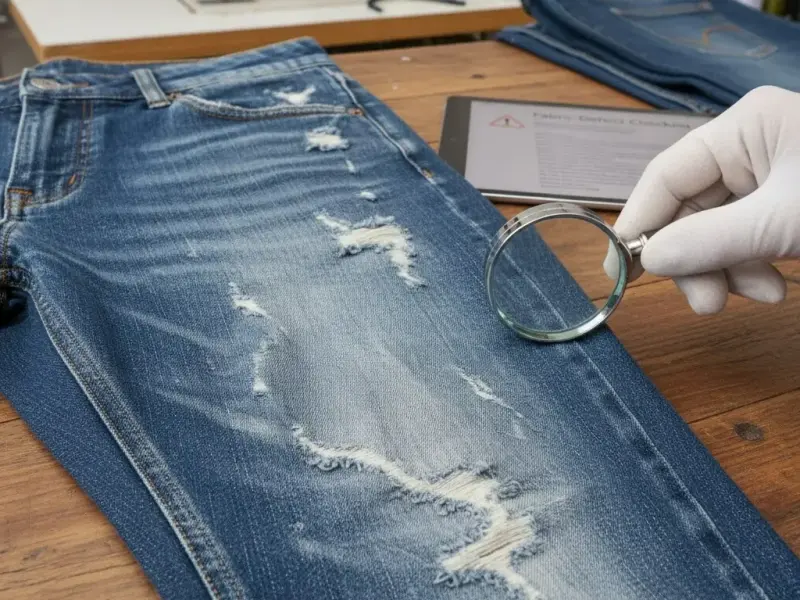
Fabric and wash defects can make a structurally sound garment unsuitable for retail. A denim jacket with carefully sewn seams may still look unacceptable if its front panels have noticeably different shades. A distressed jean may initially match the intended aesthetic but contain excessive abrasion that weakens the fabric around the pocket opening. Inspectors must evaluate both the appearance and the nature of the damage rather than assuming that every visually attractive garment will perform as intended. Typical fabric and wash concerns include:
- Shade mismatch: Unacceptable differences between panels or wash batches.
- Wash defects: Unintended streaking, irregular fading, or chemical discoloration.
- Fabric damage: Excessive distressing, abrasion, or unwanted holes.
- Contamination: Oil stains and other manufacturing residues.
- Weaving defects: Irregularities outside the approved fabric appearance.
- Backstaining: Unwanted dye redeposition.
Not every irregularity is a defect. A slub texture may be an approved characteristic of the selected denim fabric, while asymmetric fading may be part of a deliberately aged design. The deciding factor is whether the garment matches the agreed product reference and durability requirements. A well-defined wash approval should identify where variation is acceptable, where it is not, and which surface effects must be reproduced consistently throughout the production order.
What Causes Measurement and Construction Defects?
Construction defects can emerge or become more noticeable after washing. Leg twisting, for instance, may result from fabric skew, cutting alignment, pattern balance, sewing tension, or dimensional changes during laundering. It cannot always be attributed to poor sewing. Uneven leg lengths, misplaced pockets, puckered seams, insufficient reinforcement, and incorrect waistband dimensions likewise require investigation of earlier production stages. Treating a visible symptom without identifying its source can allow the same problem to recur in the next batch.
Suppose a jean has an approved inseam of 76 cm with a tolerance of ±1 cm, but its finished inseam measures 73.8 cm. It is 2.2 cm below the target and 1.2 cm below the minimum acceptable value. In a separate laundering test, an inseam changing from 80 cm to 77.6 cm represents a dimensional change of −3%. These are different measurements of quality, and their acceptance depends on the approved specification or applicable test protocol.
How Are Critical, Major, and Minor Defects Classified?
Defect classification gives manufacturers and sourcing teams a shared basis for acceptance decisions. Critical defects involve serious safety or compliance concerns, major defects substantially affect function or saleability, and minor defects involve less consequential deviations from the agreed standard. Classification depends on the product and the specific circumstances. An insecure component on children’s apparel, for example, may require a different response from a comparable cosmetic hardware issue on an adult denim jacket.
| Defect | Typical Classification | Practical Consequence |
|---|---|---|
| Broken needle fragment | Critical | Potential injury |
| Dangerous sharp metal edge | Critical | Safety risk |
| Open crotch seam | Major | Possible failure during wear |
| Nonfunctional zipper | Major | Loss of garment function |
| Unacceptable wash shade | Major, depending on severity | Retail appearance mismatch |
| Measurement outside tolerance | Per agreed defect rules | Incorrect fit or silhouette |
| Insecure rivet | Major or critical, depending on risk | Functional or safety concern |
| Small removable thread end | Minor, where specified | Cosmetic issue |
| Incorrect size label | Major, typically | Wrong product identification |

These classifications are examples and must be checked against the customer’s quality manual. A zero-acceptance rule is frequently specified for critical defects, meaning that one detected critical nonconformity triggers rejection or formal escalation under the agreed procedure. Finding no critical defects in a sample does not establish that every garment is free from safety hazards. Appropriate preventive controls and product-specific compliance verification remain necessary, particularly for products intended for children.
How Is Final Inspection Performed for Denim Apparel?
Final inspection involves confirming production readiness, reviewing approved specifications, selecting garments according to the inspection plan, checking appearance and measurements, evaluating construction and hardware, verifying identification and packing, and recording findings. Results are assessed against agreed defect classifications and acceptance criteria. When requirements are not met, the affected goods must be addressed through appropriate corrective action and reassessment before authorized shipment release.
What Documents Are Required Before Final Inspection?
Reliable inspection begins with accurate documentation. If an inspector uses an obsolete measurement chart or an unapproved wash sample, the inspection can produce a misleading result regardless of how carefully garments are examined. Technical documents should therefore be identified by style, revision, and approval status. The production team and quality staff should work from the same requirements, with any conflicts resolved before the inspection rather than left to interpretation at the end of the order. The principal documents and references include:
- Purchase order and style-color-size quantity breakdown.
- Latest approved tech pack and pre-production sample.
- Finished garment size specification and measuring instructions.
- Approved wash sample or shade band.
- Fabric, stitching, and trim specifications.
- Customer quality manual and defect classification rules.
- Label, barcode, folding, and carton instructions.
- Applicable test protocols and inspection acceptance requirements.
Version control is particularly important when product details change during sample development. Suppose the initial inseam specification is 76 cm, but a fitting session leads to an approved revision of 78 cm. If the quality team continues using the original document, properly manufactured garments may be incorrectly rejected. The same problem can arise with pocket placement, thread color, or wash appearance. Keeping approved references synchronized helps prevent unnecessary rework and disputes.
How Are Finished Garments Selected and Inspected?
Garment selection should represent the defined production lot rather than the cartons most convenient to reach. A 6,000-piece order containing three wash colors, two styles, and six sizes could contain up to 36 style-color-size combinations. If those styles or wash groups constitute separate lots under the inspection agreement, each must be assessed using its applicable plan. A representative selection helps avoid overlooking problems associated with a particular production group or size range. A practical inspection sequence includes:
- Confirm inspection readiness: Verify completed quantities and agreed packing status.
- Review documentation: Verify the current technical documents and approval references.
- Select inspection samples: Follow the agreed sampling or screening procedure.
- Check garment appearance: Examine fabric appearance, wash effects, and distressing.
- Verify measurements: Measure garments at the specified points and record deviations.
- Inspect workmanship: Examine stitching, construction, pockets, and hardware functionality.
- Check shipment requirements: Verify labels, barcodes, quantities, packaging, and required test records.
- Evaluate inspection results: Record findings and apply the agreed acceptance rules.
Sampling and measurement are separate parts of inspection planning. The overall workmanship sample may contain 200 garments, for example, while a detailed dimensional inspection may follow a separately agreed allocation by style and size. The report should identify the actual number of garments checked for each requirement. Without that information, a sourcing manager may incorrectly assume that every performance property and measurement point was verified on the entire sample or production lot.
What Should a Final Inspection Report Include?
A useful inspection report allows a sourcing team to understand the condition of an order without being physically present at the factory. A simple pass statement cannot establish which goods were selected, which reference samples were applied, or whether any issues remain unresolved. The report should identify the relevant lot, inspection conditions, actual sample sizes, defect findings, and acceptance criteria so that the shipment decision can be reviewed against the original agreement. A complete report typically records:
- Inspection date, location, order number, and style identification.
- Total lot quantity, available quantity, and actual sample size.
- Sampling standard, inspection level, and acceptance limits.
- Critical, major, and minor nonconformity findings.
- Measurement records, wash comparisons, and defect photographs.
- Packaging results, outstanding tests, and unresolved requirements.
- Overall inspection outcome and any corrective actions or release conditions.
Photographs should provide enough context to identify the problem, such as the complete garment area and measuring tape position for a dimensional deviation. For new suppliers or complex orders, independent inspection can provide another source of evidence. However, a third-party inspection still covers the agreed sample and inspection scope. It does not replace effective production control or establish that every unit in the order meets every applicable quality and performance requirement.
Which Quality Standards Apply to Denim Final Inspection?
Denim final inspection follows approved customer specifications, measurement tolerances, defect classifications, wash references, testing requirements, and agreed acceptance criteria. ISO 2859-1 provides a recognized framework for attribute-based acceptance sampling. AQL 1.5, 2.5, and 4.0 represent different acceptance quality limits. These sampling plans assess production lot conformity, while 100% finished garment screening addresses individual garment quality within a defined inspection scope.
What Is AQL in Denim Quality Control?
AQL stands for Acceptance Quality Limit. It is an index used in statistical acceptance sampling schemes, rather than a guaranteed maximum percentage of defective garments in an individual shipment. ISO 2859-1:2026, published in January 2026, establishes sampling schemes for inspection by attributes and replaces the 1999 edition and its amendments. The standard is available from ISO at https://www.iso.org/standard/2859-1. The applicable edition and sampling conditions should be specified in the inspection agreement.
The following conventional normal single-sampling examples use General Inspection Level II and count nonconforming units. Ac is the acceptance number; Re is the rejection number. The figures follow publicly available conventional sampling tables at https://aqlchart.com/learn/aql-sample-size-chart-general-level-ii/. Confirm the contracted standard and its applicable tables, switching rules, inspection severity, and lot definition before using these thresholds to release actual merchandise on an active production order.
| Lot Size | Sample Size | AQL 1.5 Ac/Re | AQL 2.5 Ac/Re | AQL 4.0 Ac/Re |
|---|---|---|---|---|
| 151–280 | 32 | 1/2 | 2/3 | 3/4 |
| 281–500 | 50 | 2/3 | 3/4 | 5/6 |
| 501–1,200 | 80 | 3/4 | 5/6 | 7/8 |
| 1,201–3,200 | 125 | 5/6 | 7/8 | 10/11 |
| 3,201–10,000 | 200 | 7/8 | 10/11 | 14/15 |
| 10,001–35,000 | 315 | 10/11 | 14/15 | 21/22 |
How Do AQL 1.5, 2.5, and 4.0 Differ?
Consider a defined lot of 5,000 jeans, inspected under the conventional General Level II normal single-sampling example above. The sample contains 200 garments. At AQL 1.5, eight nonconforming units reach the rejection number; at AQL 2.5, the rejection number is eleven; at AQL 4.0, it is fifteen. Eight major nonconforming garments would therefore fail the first criterion but could satisfy the second, provided all other requirements are met.
A frequently encountered apparel arrangement uses zero acceptance for critical defects, AQL 2.5 for major defects, and AQL 4.0 for minor defects. This is not a universal obligation. Different products and customers may require stricter criteria, alternative inspection levels, or additional controls. AQL limits should be agreed before production and not changed merely to obtain a passing result. A statistical pass also does not override a failed mandatory safety test, an unresolved measurement requirement, or other independent contractual conditions.
What Happens When Final Inspection Fails?
A failed inspection requires investigation and an appropriate disposition of the affected lot. If eleven major nonconforming garments are found in a sample of 200 under the conventional AQL 2.5 example, the lot fails that sampling criterion. Replacing only those eleven garments does not establish that the remaining goods are acceptable. Similar nonconformities may exist elsewhere in the lot, so the manufacturer must determine the extent of the problem before arranging further inspection. An appropriate response generally includes:
- Hold the affected lot from shipment.
- Identify affected styles, sizes, wash batches, and production groups.
- Investigate the underlying cause and determine the extent of nonconformity.
- Complete sorting, rework, replacement, or another approved disposition.
- Verify corrective actions and arrange reinspection under the agreed rules.
- Obtain the required shipment authorization.

Some defects, such as incorrect hangtags or removable loose threads, can be corrected relatively easily. Excessive distressing, irreversible wash differences, or incorrect post-wash dimensions may require replacement or another approved solution. Combining 100% screening with AQL sampling helps address different risks: the former identifies observable individual garment problems and the latter supports statistical lot acceptance. Neither approach guarantees zero defects, and both depend on clear inspection criteria and competent execution.
How Does Jeanzio Ensure Denim Quality Before Shipment?
Jeanzio combines 100% finished garment inspection with AQL 2.5 or customer-specified quality standards. Our final checks cover appearance, washing effects, dimensions, stitching, hardware, decorations, labels, and pre-packing condition. Approved samples and technical specifications guide inspection decisions, while the requirements of each project determine the relevant verification frequency, performance testing, supporting documentation, acceptance criteria, and any additional conditions for shipment release.
How Does Jeanzio Perform 100% Finished Garment Inspection?
Our finished garment inspection recognizes that two products made from the same fabric and pattern can still develop different visible characteristics during sewing, washing, or finishing. Every finished garment undergoes individual screening within the defined inspection scope. The purpose is to identify observable nonconformities before garments proceed to shipment preparation. Our documented quality practice combines this screening with AQL 2.5 or the customer’s specified acceptance requirements for assessing the production lot. The principal finished garment inspection areas are:
- Garment appearance and visible fabric defects.
- Wash effects and approved appearance boundaries.
- Finished garment dimensions and stitching workmanship.
- Buttons, rivets, zippers, and other hardware.
- Decorations, distressing, labels, and pre-packing condition.
For a 10,000-piece order, individual screening covers all 10,000 finished garments within its defined scope. A separate statistical inspection may examine a smaller sample according to the agreed plan. Individual screening does not mean that every garment undergoes destructive testing, every laboratory performance test, or every possible dimensional measurement. Establishing the verification frequency for each characteristic helps customers understand the evidence behind the quality assessment rather than relying on an undefined promise of perfect quality.
How Are Bulk Garments Checked Against Approved Samples?
Consistency begins with a clear definition of the product. A rigid straight-leg jean may require particular attention to silhouette and inseam dimensions, while a stretch skinny jean may need additional evaluation of fabric recovery. A vintage jacket may permit a broader range of fading within approved limits. At Jeanzio, we use customer-approved references to establish the relevant expectations rather than applying the same appearance and measurement criteria to every denim collection. Our quality reference hierarchy prioritizes:
- Customer quality manual, purchase order, tech pack, and test protocol.
- Approved pre-production sample, wash sample, and shade band.
- Approved pattern, size specification, and measurement tolerances.
- Applicable internal quality requirements.
Where requirements conflict, the difference should be resolved with the customer before bulk production. Defining wash limits, measurement points, and acceptable tolerances during development gives these requirements time to influence fabric selection, pattern allowances, sewing preparation, and wash trials. Waiting until the order is completed leaves fewer practical correction options. For a complex fashion denim collection, a well-maintained approval reference can be as important as the final inspection report itself.
How Can You Evaluate a Denim Manufacturing Partner?
Attractive samples and competitive pricing are important, but they do not demonstrate how a manufacturer will maintain quality across repeated orders. Ask how the factory controls wash differences, communicates approved specifications to production staff, handles dimensional changes, and investigates recurring defects. A supplier should also be able to explain the difference between individual garment inspection and statistical acceptance sampling, including which inspection criteria apply to the particular styles under development.
Useful evidence to request includes anonymized measurement records, approved shade references, inspection checklists, defect photographs, and corrective action records, subject to project availability and confidentiality requirements. Independent laboratory reports should identify the material or garment tested, the test method, date, and scope. A report for one denim fabric does not automatically establish the performance of other fabrics, washes, or finished products. Evidence is most useful when it can be traced to the relevant product and agreed requirement.
Conclusion
Reliable final inspection starts well before garments reach the packing department. It begins with an approved design, a realistic measurement specification, suitable fabric and trim choices, and a clear definition of acceptable wash appearance. At Jeanzio, we welcome brands and sourcing teams to share their tech packs, reference images, intended order quantities, size specifications, and quality requirements during development. Establishing these details together creates a stronger basis for consistent manufacturing, practical quality verification, and informed shipment decisions.
Frequently Asked Questions
What Is Final Random Inspection for Denim Garments?
Final random inspection is a sample-based evaluation of completed denim garments before shipment. Selected units are examined for the agreed quality characteristics, and the findings are compared with the specified acceptance criteria. Unlike 100% screening, random inspection does not examine every garment. Its reliability depends on appropriate lot definition, representative random selection, the agreed sampling plan, and accurate classification of the nonconforming units or nonconformities found during inspection.
When Should Denim Final Inspection Take Place?
Denim final inspection should occur after sewing, washing, and finishing have been completed, when garments can be compared with their approved finished specifications. Individual garment screening may take place before packing, while a separate pre-shipment inspection may require a specified proportion of the order to be packed. The precise readiness requirement should be agreed with the manufacturer or independent inspection provider, allowing enough time to resolve any findings before dispatch.
Is AQL 2.5 a Good Standard for Denim Apparel?
AQL 2.5 is a commonly encountered acceptance quality limit for major apparel defects, but its suitability depends on the product, defect consequences, supplier performance, and contractual quality requirements. Under a conventional normal General Level II sampling plan, a lot of 5,000 garments has a 200-piece sample and an AQL 2.5 acceptance number of ten. This does not mean that 2.5% defective garments are automatically permitted in every shipment.
How Do You Check Denim Wash Consistency?
Denim wash consistency is checked by comparing finished garments with an approved wash sample or physical shade band under agreed viewing conditions. Inspectors assess overall shade, fading, whiskers, abrasion, distressing, and differences between panels or washing batches. Intentional variation may be acceptable when it falls within the approved range. Physical references are particularly useful because photographs and digital screens can change the perceived shade or contrast of denim garments.
What Is the Difference Between 100% Inspection and AQL?
A 100% inspection screens every finished garment for the defined characteristics, whereas AQL-based acceptance sampling examines selected units to assess an entire production lot under an agreed statistical plan. The two methods can be used together because they address different quality risks. Neither guarantees that all garments are defect-free, and individual screening does not necessarily include every measurement point or destructive performance test on each finished product.
What Happens If a Denim Order Fails Final Inspection?
If an order fails final inspection, the affected lot should be held while the manufacturer investigates the nature and extent of the problem. Depending on the findings, sorting, repairs, replacements, or another approved disposition may be required. Corrective actions should be verified and reinspection performed under the agreed rules before shipment authorization. Replacing only the nonconforming garments found in the sample is not enough to establish the quality of the remaining lot.