Skip to content

Cargo denim shorts can look simple in an online photo: denim fabric, a waistband, a fly, and a pair of large side pockets. In actual product development, those pockets change much more than the appearance. Their size affects the visual width of the leg, their position changes the balance between hip and hem, their weight influences drape, and their construction can alter how the side seam behaves after washing. That is why two garments sold under the same “cargo denim shorts” name can feel completely different in fit, durability, comfort, and overall quality.
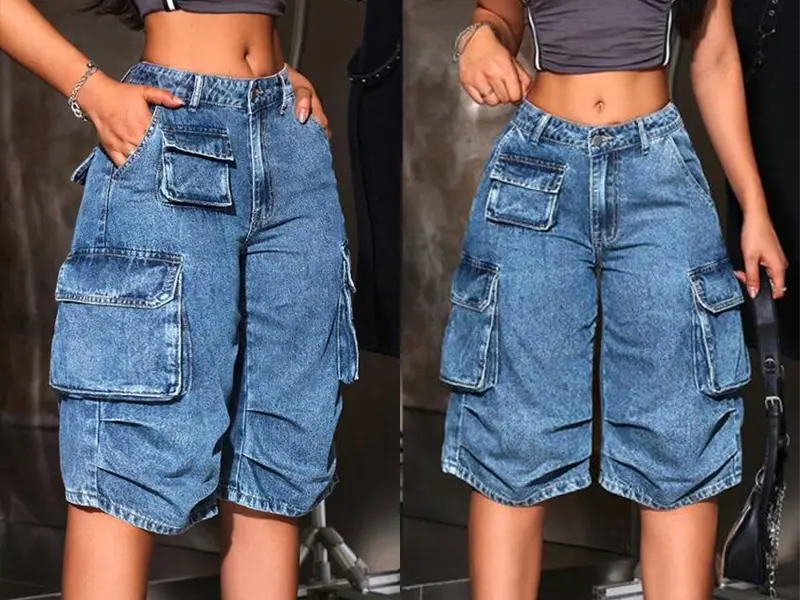
Cargo denim shorts are denim shorts built with cargo-style utility details, especially large patch, flap, pleated, or expandable pockets positioned around the thigh. They combine the familiar structure, fading, and wash character of jeans with the storage and workwear language of cargo clothing. Depending on rise, leg width, length, fabric weight, pocket construction, and wash, they can look clean, rugged, relaxed, streetwear-driven, or fashion-forward.
Today, the category stretches from short high-rise women’s styles to relaxed Bermudas, oversized cargo jorts, children’s utility shorts, raw-hem versions, and heavyweight workwear-inspired designs. The interesting part is that the name tells you only the starting point. To understand whether a pair is well designed, you need to look at the pocket architecture, the proportion of the silhouette, the denim weight, the wash, and the way all of those elements hold together after real wear. Once you start noticing those details, cargo denim shorts become much easier to read as a product rather than just a trend.
What Are Cargo Denim Shorts?
Cargo denim shorts are a hybrid of jean shorts and cargo clothing. Denim provides the familiar jean structure, indigo character, fading, topstitching, and wash effects, while cargo pockets add storage volume and a utility-inspired appearance. They can be short, Bermuda-length, or jort-length; fitted or oversized; rigid or stretch. The defining feature is that utility pockets are a meaningful part of the garment’s construction and visual identity.
What Makes Denim Shorts “Cargo”?
The easiest way to identify cargo denim shorts is to look at the leg, not just the waistband. Standard jean shorts usually rely on the familiar five-pocket language: two front scoop pockets, a coin pocket, and two rear patch pockets. Cargo denim shorts add one or more larger utility pockets on the outer or front-side thigh. These pockets may be flat patch pockets, flap pockets, pleated pockets, bellows pockets, or layered compartments, and they usually become one of the first things you notice when the garment is worn.
A true cargo design is more than a decorative flap stitched onto a basic short. The utility pocket should contribute to the proportion, function, or visual structure of the garment. On a clean fashion style, that may mean a relatively flat pocket with a neat flap and restrained topstitching. On a workwear or streetwear style, the pocket may be deeper, three-dimensional, reinforced, or combined with extra seams and hardware. The more dimensional the pocket becomes, the more it affects fabric consumption, sewing time, wash behavior, and bulk consistency.
JEANZIO’s internal denim product system places cargo within the wider denim-shorts family alongside Bermuda, relaxed, cut-off, carpenter, high-waist, and raw-hem styles. In practice, that classification is useful because it shows that “cargo” describes a construction and styling direction, not one fixed fit. The same cargo concept can be applied to a short women’s style, a loose men’s Bermuda, or a long jort, provided the pockets remain a meaningful part of the design.
Are Cargo Denim Shorts Functional or Fashion-Driven?
They can be genuinely functional, mainly decorative, or deliberately positioned between the two. A functional cargo pocket needs enough usable depth and opening width for the intended contents, and it should remain stable when loaded. If the product is designed to carry a phone, wallet, keys, or similar items, the developer should test the pocket with real weight inside it. A pocket that hangs perfectly when empty may pull the side seam, twist the leg, or sag noticeably once it is used.
Fashion-driven cargo pockets have a different job. Their purpose may be to exaggerate proportion, create visual width, reinforce a Y2K or streetwear mood, or make a long jort feel more directional. Designers may intentionally use oversized flaps, unusually low placement, layered pockets, shallow pocket bags, or asymmetry even when maximum storage is unnecessary. The key is to decide this early, because a decorative pocket can be engineered much more lightly than a pocket expected to perform as real storage.
This distinction has a direct effect on sampling and cost. A bellows pocket with gussets, double-layer flaps, closures, and several reinforcement points requires more pattern pieces and sewing operations than a flat patch pocket. It also creates more wash-sensitive edges and more places where left-right variation can appear. A successful design does not need the most complicated pocket; it needs a pocket whose structure matches the intended look, function, fabric, and retail position.
Where Did the Cargo Style Come From?
Cargo clothing grew out of military and workwear needs, where externally mounted pockets provided easy access to equipment and personal items. Over time, that practical pocket language moved into outdoor clothing, uniforms, skatewear, streetwear, casual fashion, and eventually denim. Denim was a natural match because it already carried its own workwear history, visible topstitching, and ability to develop character through abrasion and washing. Combining the two created a garment that could feel both familiar and utilitarian.
Modern cargo denim is far removed from a literal military uniform. Women’s versions may use a high waist, short inseam, and compact utility pockets; men’s versions may be loose and knee-length; children’s versions may use softer fabric and simplified pocket construction; fashion collections may combine cargo details with laser fading, raw hems, vintage wash, distressing, or decorative hardware. The design language has become flexible enough to move between clean commercial basics and more exaggerated fashion pieces.
The history still matters because it explains why believable construction usually improves the final product. Even a fashion-led cargo pocket tends to look more convincing when the opening is usable, the flap is proportionate, the stitch lines make structural sense, and high-stress areas are reinforced where needed. The strongest contemporary cargo denim does not copy military garments literally. It borrows the logic of utility clothing and adapts that logic to modern fit, wash, and styling.
What Features Define Cargo Denim Shorts?
Cargo denim shorts are defined by the relationship between their utility pockets, silhouette, denim, and construction details. Large thigh pockets are the strongest visual signal, but pocket type, placement, flap shape, topstitching, bartacks, panel seams, hardware, leg width, hem treatment, and wash all influence the result. These elements should be developed together because changing one can affect both the look and the physical behavior of the garment.
What Types of Cargo Pockets Are Used?
A flat patch pocket is the simplest and cleanest option. It lies close to the leg, adds relatively little bulk, and works well on contemporary utility shorts where the designer wants a cargo reference without a heavily military appearance. A flap patch pocket adds a separate flap and can use snaps, buttons, hook-and-loop tape, or no closure at all. The flap creates a stronger cargo identity but also introduces another component that can curl or shift after washing.
Pleated and bellows pockets add more volume. A center pleat or side pleats can make a pocket appear fuller without using a complete gusset. A bellows pocket uses folded or separate side and bottom sections so the pocket can expand outward. It offers greater storage and a stronger workwear look, but it is more demanding to manufacture because fold depth, corners, flap alignment, topstitching, and left-right symmetry must all remain stable. Layered pockets go further by adding zipper compartments, small outer pockets, webbing, or secondary flaps.

More components do not automatically make a better garment. Every additional layer adds fabric, seam thickness, wash interaction, operation time, and inspection points. On a lightweight summer short, a simple flat pocket may give a cleaner result than a heavy bellows construction. On a structured jort, the extra volume may be exactly what makes the product feel intentional. Good pocket selection is therefore a design decision and a manufacturing decision at the same time.
| Pocket Type | Typical Structure | Visual Effect | Common Manufacturing Concern |
| Flat patch | Single main pocket panel | Clean, modern utility | Position and symmetry |
| Flap patch | Patch pocket plus separate flap | Stronger cargo identity | Flap curl and alignment |
| Pleated pocket | Center or side pleat | Moderate added volume | Pleat consistency |
| Bellows pocket | Side and/or bottom gussets | Strong workwear volume | Fold depth and corner accuracy |
| Layered pocket | Multiple pocket components | Technical or streetwear look | Bulk and operation count |
| Zipper cargo | Pocket with zipper opening | Modern functional look | Zipper distortion after wash |
How Do Pocket Size and Placement Change the Look?
Pocket placement is one of the most underestimated parts of cargo design. A large pocket positioned too high can make the hip area appear wider; one positioned too low can make the leg look visually shorter or bottom-heavy. A pocket placed too far toward the front may dominate front-view photography, while one placed too far back can disappear from the main view and become uncomfortable when the wearer sits. These differences may involve only a few centimeters, but they can change the overall proportion dramatically.
Pocket size should also follow the available leg area. A pocket that works on a 10- or 12-inch jort can overwhelm a short 3- or 4-inch inseam because it occupies most of the visible thigh. The reverse problem is equally common: an undersized pocket on an oversized jort can look accidental or weak. Designers should therefore establish rise, garment length, hip ease, and leg width first, then place the cargo pocket within that architecture rather than treating the pocket as an isolated graphic shape.
For repeatable production, pocket width, finished height, flap depth, vertical position, and distance from the side seam should be measurable specification points. Flat measurements confirm whether the pocket can be reproduced consistently, while on-body review shows whether the visual balance is correct. Both are necessary. A pocket can meet its specification exactly and still look wrong if the specification itself does not suit the body block, rise, or overall silhouette.
Which Details Reinforce High-Stress Areas?
Cargo pockets usually experience more handling than decorative pockets, especially when customers actually use them for storage. The upper corners of a pocket opening, flap attachment points, snap or button areas, belt loops, zipper ends, and intersections with panel seams can all become high-stress zones. Common reinforcement methods include bartacks, double-row topstitching, localized backing fabric, stronger seam constructions, and hardware reinforcement where appropriate. The aim is to strengthen the real load path without making the garment unnecessarily stiff.
Bartacks are especially useful around pocket corners and other concentrated stress points because a short, dense stitch pattern can add strength without requiring a large reinforcement patch. In cargo production, however, more reinforcement is not automatically better. A very dense bartack on lightweight 8-ounce denim can create a hard spot or visible puckering, while an oversized rivet attached to soft fabric without proper backing may simply tear the surrounding denim under load.
The reinforcement plan should therefore follow the product’s intended use. A compact women’s fashion pocket used mainly for styling has different needs from a large men’s cargo pocket expected to hold a phone, keys, and a wallet. JEANZIO’s production mapping treats cargo styles as multi-pocket garments that require deliberate reinforcement rather than as basic five-pocket shorts. That distinction is practical because it connects design decisions to the actual sewing and quality-control operations needed in bulk production.
Do All Cargo Denim Shorts Have Multiple Pockets?
There is no universal number of pockets required for cargo denim shorts. Some designs retain the classic five-pocket jean layout and add one large cargo pocket to each leg, producing seven or more usable pockets. Other designs simplify the front or back construction and use fewer total pockets, while oversized streetwear styles may add layered compartments, zipper pockets, or asymmetrical layouts. The product still reads as cargo when utility pockets remain a meaningful visual and structural feature.
Pocket count should follow function and proportion rather than a formula. Every additional pocket adds fabric consumption, thread, sewing operations, templates, alignment points, wash surface area, and inspection work. More pockets can also add weight to one side of the garment or create unnecessary thickness where several layers overlap. For a clean commercial style, four or five well-developed pockets may be more convincing than eight pockets that do not contribute to the silhouette or actual use.
Before bulk production, each cargo pocket should have a defined finished size, placement reference, flap specification, gusset or pleat depth where relevant, stitch type, topstitch distance, closure position, and reinforcement points. That level of detail is what turns the idea of “multiple pockets” into a repeatable product. It also makes later revisions easier because the team can identify exactly which variable changed instead of comparing two samples only by eye.
How Are Cargo Denim Shorts Different From Other Shorts?
Cargo denim shorts differ from regular denim shorts because utility pockets become part of the structure, and they differ from traditional cargo shorts because denim introduces jean-specific fading, shrinkage, topstitching, and wash behavior. Cargo jorts overlap strongly with cargo denim shorts but usually describe longer, looser jean-short silhouettes. Carpenter shorts are related through workwear styling, although their pocket language is more tool-oriented than storage-oriented.
How Are Cargo Denim Shorts Different From Regular Denim Shorts?
Regular denim shorts normally begin with classic jean construction: a waistband, fly, front scoop pockets, coin pocket, rear patch pockets, belt loops, yoke, and familiar topstitching. Their visual identity often comes from fit, denim shade, hem treatment, and wash. Cargo denim shorts add a second design system through larger external pockets, flaps, panel seams, or gussets. Those additions influence not only the appearance but also the number of pattern pieces, sewing operations, reinforcement points, and measurement references.
The practical difference becomes clear during development. A standard five-pocket short may mainly need fit, wash, pocket placement, and seam quality control. A cargo version adds questions such as whether the pocket should hold real weight, whether the flap remains flat after washing, whether a bellows section keeps its shape, whether the pocket scales properly across sizes, and whether the added weight pulls the side seam forward. These issues are why cargo construction is usually more complex than an otherwise similar basic denim short.
For assortment planning, the distinction can also be useful. A regular denim short often works as a dependable core item because its styling is familiar and easy to combine. Cargo denim can play a stronger seasonal, fashion, workwear, or streetwear role because the utility pockets give it more visual identity. Neither category is inherently better; they simply solve different product needs, and their development priorities are not the same.
Are Cargo Denim Shorts the Same as Cargo Jorts?
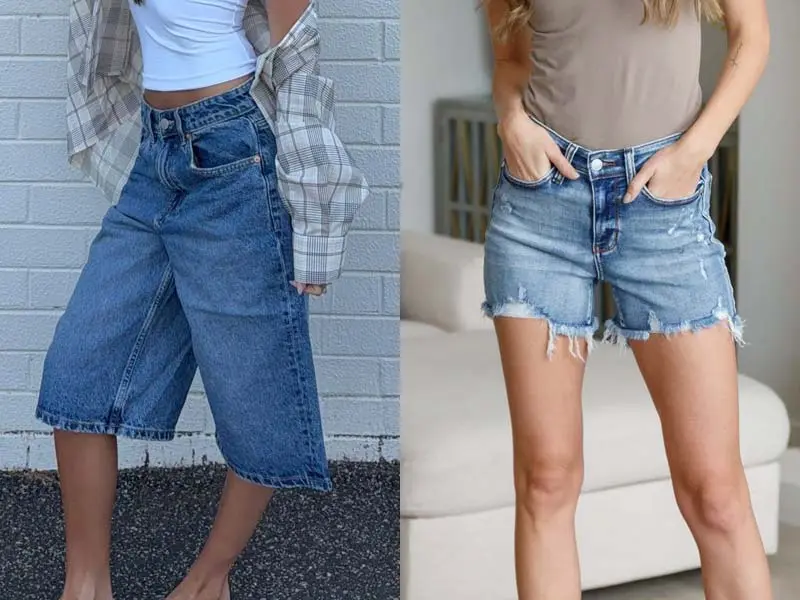
The terms overlap heavily, but they are not always used in exactly the same way. “Jorts” comes from “jean shorts,” so a cargo jort is technically a type of cargo denim short. In current fashion language, however, “jorts” often suggests a longer, wider, more relaxed silhouette that reaches toward the knee or sits around it. That is why cargo jorts are frequently associated with oversized pockets, baggy legs, long inseams, skatewear, and streetwear styling.
Cargo denim shorts is the broader category. It can include a short high-rise women’s style, a mid-length relaxed short, a knee-length Bermuda, a children’s utility short, or a long baggy jort. Cargo jorts usually occupy the longer and looser end of that spectrum. The difference is therefore more about silhouette and market language than about a strict technical rule. A product page may call the same garment “cargo denim shorts” in one season and “cargo jorts” in another depending on how the brand wants to position the fit.
For product development, the name alone is never enough. A factory still needs measurable information such as rise, inseam, outseam, hip ease, leg opening, pocket dimensions, fabric weight, wash target, and hem treatment. “Cargo jort” communicates an idea, but those measurements turn the idea into a reproducible garment. This is especially important when the style is intentionally oversized, because different brands use “baggy” and “long” in very different ways.
How Do Cargo Denim Shorts Differ From Cargo Shorts?
The main difference is the base material system. Traditional cargo shorts are commonly made from cotton twill, canvas, ripstop, poplin, nylon blends, or other utility fabrics. These materials may be piece-dyed, garment-dyed, or finished for durability, and they often use drawcords, elastic waists, technical closures, or military-inspired detailing. Cargo denim shorts use denim as the main fabric, which brings a different combination of structure, indigo character, topstitching, abrasion, fading, and wash effects.
Denim also behaves differently during manufacturing. Indigo shade may vary between lots, and the wash process can change color, handfeel, shrinkage, seam appearance, and pocket shape. Thick seams often develop stronger highs and lows, while pocket edges may become more pronounced after stone, enzyme, or abrasion treatments. A flap that appears perfectly flat before washing can curl afterward, and a three-dimensional pocket may tighten or become more structured as the fabric shrinks.
Traditional cargo shorts can certainly be fashion-led, and cargo denim can be genuinely functional, so the difference is not simply “utility versus fashion.” It is better understood as cargo architecture expressed through different material systems. Denim adds a layer of wash engineering and post-wash measurement that does not behave in the same way as stable dyed twill. That makes material selection and wash approval especially important when the cargo pocket has several layers or complex folds.
How Are Cargo Denim Shorts Different From Carpenter Shorts?
Cargo and carpenter shorts both draw from workwear, so modern fashion often blends the two. Their original functional logic is different. Cargo garments are built around larger storage pockets, typically placed on the thigh and sometimes expanded with pleats or gussets. Carpenter clothing is more closely associated with tool-specific details such as hammer loops, ruler pockets, narrow utility pockets, reinforced seams, and workwear panel construction. One prioritizes general storage volume; the other originally organized tools.
That difference affects the visual language. Cargo shorts often show one or two large pockets with strong flaps, while carpenter shorts may use smaller elongated pockets and loops that sit closer to the side seam. Hybrid styles are increasingly common, especially in long denim shorts and jorts. A designer may combine a cargo flap pocket on one leg with a hammer loop on the other, add rivets, or use carpenter-style seam lines around a baggy cargo silhouette.
For product specification, using the correct terminology helps prevent miscommunication. If a reference image shows tool pockets and a hammer loop, calling it only “cargo” may lead the development team toward the wrong pocket structure. If the key feature is a large expandable thigh pocket, “carpenter” may understate the design. The labels are related, but the pattern pieces, sewing sequence, and intended function can be quite different.
| Feature | Regular Denim Shorts | Cargo Denim Shorts | Traditional Cargo Shorts | Carpenter Shorts |
| Main material | Denim | Denim | Twill, ripstop, canvas, blends | Denim, canvas, twill |
| Main pocket language | Five-pocket jean layout | Large thigh utility pockets | Large utility pockets | Tool and ruler pockets |
| Pocket volume | Low to moderate | Moderate to high | Moderate to high | Usually specialized |
| Hammer loop | Rare | Optional | Rare | Common |
| Denim wash effects | Central | Central | Usually limited | Common when denim |
| Typical fit range | Fitted to relaxed | Fitted to oversized | Usually relaxed | Straight to loose |
| Key development risk | Fit and wash | Pocket, fit, and wash interaction | Pocket durability | Tool-detail proportion |
Which Fits and Lengths Are Common?
Cargo denim shorts can be fitted, straight, relaxed, baggy, Bermuda-length, or oversized. There is no single correct rise or inseam. The most important variables are waist position, hip ease, front and back rise, crotch depth, thigh width, leg opening, overall length, and pocket proportion. These measurements must be developed together because changing the silhouette also changes where the cargo pockets look and function best.
Are Cargo Denim Shorts Usually Baggy?
Baggy cargo denim is highly visible in current fashion, but bagginess is not a requirement. Relaxed and oversized silhouettes naturally suit large cargo pockets because the wider leg gives the pocket room to sit without making the thigh feel crowded. This works particularly well for knee-length jorts, skate-inspired styling, workwear looks, and streetwear collections. A wider leg also allows designers to use deeper bellows pockets or larger flaps without visually overwhelming the body.
Slimmer cargo shorts can still work, especially in women’s fashion, but pocket scale needs more restraint. A deep three-dimensional pocket on a narrow thigh can make the leg look wider, interfere with movement, or pull the side seam outward. A flatter pocket, shallower pleat, or smaller flap often suits a closer silhouette better. The goal is not to force every cargo short into the same oversized formula but to make the pocket feel proportionate to the body block and intended style.
For accurate development, words such as “baggy,” “relaxed,” and “oversized” should be converted into measurable points such as waist, hip, front rise, back rise, thigh width, leg opening, inseam, and outseam. Two brands can use the word “baggy” while specifying very different amounts of ease. The measurements establish repeatability, while the fit sample confirms whether the result actually looks relaxed in the intended way rather than simply appearing one size too large.
Which Lengths Create Short, Bermuda, and Jort Fits?
Length terminology varies considerably between brands, so inseam and finished outseam are more reliable than product names alone. As a practical commercial reference, short fashion styles often fall around a 2-5 inch inseam, mid-length shorts around 5-8 inches, Bermuda directions around 8-11 inches, and long jorts around 10-13 inches or more. These are working ranges rather than universal standards because body height, rise, size, and intended knee position all change how a measurement appears.

The same 10-inch inseam can look clearly above the knee on a tall wearer and much closer to the knee on a shorter wearer. For that reason, product developers often combine numerical measurements with a fit reference or target body. The pocket should then be scaled after the basic length is established. A long jort provides enough vertical area for a large bellows pocket, layered compartments, or low placement, while a short inseam usually requires a smaller and more compact pocket arrangement.
Length also affects the character of the garment. Shorter cargo denim often feels more fashion-led or summer-focused, while longer Bermudas and jorts can feel more workwear, skate, or streetwear-driven. That is not a strict rule, but it is a useful visual cue. When brands develop a collection across several lengths, keeping the pocket language consistent while adjusting the pocket scale can make the range feel connected rather than like unrelated products.
How Does Rise Change the Cargo Shorts Silhouette?
Rise controls where the garment sits on the body and changes the relationship between waist, hip, crotch, pocket, and hem. High-rise cargo shorts place the waistband closer to the natural waist and create more vertical space between the waistband and the top of the cargo pocket. This can work especially well on women’s styles where the waist is defined before the silhouette opens through the hip or thigh. The pocket can sit lower without making the garment feel visually crowded.
Mid-rise is versatile and works across many men’s and women’s cargo silhouettes because it preserves familiar jean proportions. Low-rise cargo denim creates a stronger Y2K or streetwear impression and often works with a deeper crotch or more relaxed hip. Lowering the waistband, however, is not a simple vertical adjustment. Front rise, back rise, crotch curve, hip position, waistband angle, pocket location, and sometimes yoke balance all need to be reconsidered at the same time.
This becomes particularly important after washing. If the rise or crotch balance is marginal before wash, shrinkage can make the problem more obvious. A low-rise garment may pull at the front or gap at the back, while the cargo pocket can exaggerate the imbalance by dragging visually toward one side. Fit review should therefore look at rise and pocket placement together, both before and after the intended wash process.
How Do Men’s, Women’s, and Kids’ Fits Differ?
The differences come more from target body blocks, styling, and use than from rigid gender rules. Men’s cargo denim commonly uses more hip and thigh ease, longer inseams, straighter or wider leg openings, and larger functional pockets. Women’s cargo denim covers a wider range, from short high-rise silhouettes with compact pockets to baggy Bermudas and long jorts that use proportions close to contemporary unisex streetwear. Waist-to-hip relationship, seat shape, rise, and thigh ease usually create the most noticeable fit differences.
Children’s cargo denim needs a separate approach rather than a simple scaled-down adult pattern. Pocket size, waistband comfort, movement, hardware, leg-opening coverage, and age-specific proportions all need attention. Large bellows pockets that look balanced on an adult can feel heavy on a small child, while long pocket flaps or unnecessary metal parts can create usability concerns. Softer denim, flatter pockets, adjustable waist solutions, and simplified closures can preserve the cargo look without making the product cumbersome.
JEANZIO’s kids’ denim framework includes relaxed and cargo shorts, loose and high-waist directions, Bermuda lengths, and controlled raw hems, with specific attention to waist comfort and movement. That kind of category separation matters because it prevents the common mistake of treating every target consumer as one master pattern. A strong cargo program may share design language across men’s, women’s, and kids’ products, but the fit blocks and pocket proportions should still be developed for each group.
Which Denim Fabrics and Washes Work Best?
Rigid denim is a strong choice when cargo shorts need structure, authentic fading, or a baggy workwear silhouette. Comfort stretch suits closer fits and movement-focused styles, while lightweight denim is useful for warm-weather products but requires more careful pocket engineering. Fabric weight, stretch, recovery, shrinkage, handfeel, and wash compatibility should be selected together because each one changes how the pockets and silhouette behave after production.
Is Rigid or Stretch Denim Better?
Neither rigid nor stretch denim is automatically better. Rigid denim is usually the more natural choice for oversized cargo jorts, relaxed shorts, vintage styling, and workwear-inspired products because it holds pocket shape and leg structure well. Since the fabric does not rely heavily on elastane for comfort, the pattern must provide adequate hip, crotch, thigh, and leg-opening ease. That makes the silhouette feel intentional rather than restrictive.
Rigid denim also responds well to many classic wash effects, including enzyme, stone, abrasion, whiskering, and vintage fading. The pocket edges and seam highs can develop attractive contrast, which often reinforces the utility look. Stretch denim serves a different purpose. It can improve comfort in fitted high-rise shorts or movement-oriented products, but the stretch percentage alone does not tell you whether the fabric will perform well. Recovery is equally important because poor recovery can lead to waistband growth, seat bagging, or distorted pockets after wear.
A useful selection process starts with the target silhouette, season, handfeel, wash, and customer rather than with fiber composition. A 100% cotton fabric is not automatically premium, and a stretch fabric is not automatically less authentic. For loose cargo jorts, rigid or low-stretch denim is often the logical starting point. For fitted or comfort-focused products, controlled stretch may improve wearability as long as the wash route does not damage the elastic system.
Which Denim Weight Works for Cargo Shorts?
Denim weight affects warmth, drape, pocket support, seam thickness, wash response, and overall handfeel. As a practical development guide, approximately 8-9.5 ounce denim often suits spring, summer, and warm-climate products; 9.5-11 ounce denim works well across many commercial shorts and cross-season styles; 11-12 ounce denim provides more structure for baggy jorts and workwear directions; and 12-13 ounce denim creates a heavier, more substantial character. These ranges are useful references rather than fixed industry rules.
The pocket structure should influence the final choice. An 8.5-ounce denim can feel comfortable for summer, but a very large bellows pocket may need extra stabilization because the fabric does not support itself strongly. A 12-ounce fabric may hold an oversized pocket beautifully, yet multiple layers at the flap, gusset, and reinforcement can become bulky and warm. The fabric should therefore be evaluated as part of the finished construction rather than only as a swatch.
JEANZIO’s material framework uses a similar season-and-structure logic and treats roughly 8-10 ounce denim as a lightweight range suited to warmer climates, shorts, shirts, skirts, and softer products. It also notes that lighter fabrics are more sensitive to seam puckering and pocket impressions. That is a useful reminder that lightweight does not mean low quality; it simply requires a different construction approach from heavier workwear denim.
| Denim Range | Common Product Direction | Typical Pocket Behavior | Main Point to Check |
| 8-9.5 oz | Summer and softer cargo shorts | More drape, less self-support | Sagging or seam puckering |
| 9.5-11 oz | Core commercial cargo styles | Balanced structure | Shrinkage and pocket stability |
| 11-12 oz | Baggy jorts and workwear | Strong pocket definition | Layer thickness |
| 12-13 oz | Heavy street/workwear styles | High structure | Bulk and warm-weather comfort |
| Comfort stretch | Fitted or movement-focused styles | Better mobility | Recovery after wear and wash |
| Rigid cotton | Baggy and vintage cargo | Strong silhouette | Sufficient pattern ease |
How Does Denim Weight Affect Pocket Structure?
Cargo pockets multiply fabric layers quickly. A bellows pocket can include the main pocket panel, folded gussets, seam allowances, a double-layer flap, reinforcement, and hardware backing. In a heavy denim, several layers may stack in the same corner, making the area difficult to feed evenly through the machine and harder to press or wash consistently. Thick pocket zones can also feel stiff against the thigh, especially on shorter garments where the pocket sits close to the body.
Lightweight denim creates the opposite set of problems. A large pocket may collapse, sag, print through the leg, or become wavy after washing. The flap may lose definition, and heavy topstitching can pucker the surrounding fabric. Developers can respond by reducing gusset depth, changing seam allowances, selecting a lighter thread, adding local stabilization, reducing hardware weight, or adjusting the size and shape of the pocket so that the construction suits the fabric rather than fighting it.
Fabric direction and shrinkage also matter. If the pocket and body panels are cut or stabilized differently, they can react unevenly during washing. This can cause curling, twisted flaps, or distorted pocket edges even when the sewing itself is technically accurate. The best fabric is therefore not simply the heaviest or softest option. It is the fabric whose structure, wash response, and handfeel support the intended pocket volume and finished silhouette.
Which Washes Suit Cargo Denim Shorts?
Cargo denim can use almost the full visual language of jeans. Clean dark rinses create a more refined utility appearance, mid-blue washes suit everyday commercial styles, and light washes feel natural for spring and summer. Vintage washes add depth around seams and pocket edges, while grinding, laser fading, raw hems, bleaching, or controlled distressing can push the style toward streetwear, festival, or retro positioning. The important point is that the wash should support the pocket construction rather than obscure it.
A useful wash brief should be more precise than a phrase such as “vintage blue.” Product developers benefit from knowing the base denim shade, target finished shade, contrast level, handfeel, whisker intensity, thigh fading, pocket-edge abrasion, grinding position, raw-hem appearance, hardware finish, distressing locations, and acceptable shade range. Those details allow the sample team and wash partner to reproduce an effect more consistently than a vague color description can.
Cargo products also need post-wash pocket review. Flaps can curl, gussets can tighten, topstitching can pucker, and thick pocket seams may abrade more strongly than the surrounding leg. In bulk, shade can vary because of fabric lots, load size, chemicals, water conditions, processing time, temperature, and local abrasion. The realistic objective is not zero variation; it is controlled variation within an approved shade and appearance window, supported by sample references and consistent inspection.
How Are Cargo Denim Shorts Developed and Made?
Cargo denim shorts are developed by connecting silhouette, pattern, fabric, pocket engineering, wash, reinforcement, and approval standards. A typical path moves from design review to pattern making, first sample, fit review, wash trial, post-wash measurement, revision, PP approval, cutting, sewing, bulk washing, finishing, inspection, and packing. The key is to approve the garment after the intended wash, because pockets and fit can behave differently from the raw sewn sample.
How Are the Fit and Pattern Developed?
Pattern development should begin with the body silhouette rather than the cargo pocket. The team first establishes rise, waist, hip, seat, crotch balance, thigh, leg opening, inseam, and overall length. Once those proportions are stable, the cargo pocket can be positioned and scaled to fit the available leg area. Starting with the pocket before the body pattern is resolved often creates unnecessary revisions because every later change to rise or leg width also shifts the pocket relationship.
When a brand provides a complete Tech Pack, the developer can review POM measurements, construction, fabric, pocket dimensions, topstitching, trims, and wash requirements directly. When the starting point is a reference image, more information has to be reconstructed. A front-view photo does not reveal back-rise balance, rear-pocket dimensions, internal pocket bags, fabric stretch, waistband construction, shrinkage allowance, or true garment measurements. Those missing elements should become explicit development decisions rather than guesses hidden inside the sample.
JEANZIO’s image-development process follows that logic by first reading rise, hip and thigh ease, leg opening, length, crotch balance, and overall silhouette, then verifying the assumptions through physical fit samples and post-wash measurements. This is especially important on cargo shorts because the large pockets act almost like visual rulers. If the rise, side seam, or thigh width is poorly balanced, the pocket makes the problem more obvious rather than hiding it.
How Are Cargo Pockets Positioned and Constructed?
A production-ready specification should replace vague instructions such as “large pocket on side leg.” The pattern and sample team should know the finished pocket width and height, the distance from the waistband or side seam, the flap depth, gusset or pleat amount, topstitch distance, closure location, reinforcement position, and any intended angle. These dimensions are especially important when the left and right pockets need to appear symmetrical in front-view or side-view photography.
Templates can improve repeatability because cargo pockets have several visible edges, corners, and fold lines. JEANZIO’s manufacturing setup includes seven template pocket machines and ten bartack machines among its relevant pocket and reinforcement equipment, allowing suitable cargo operations to be standardized where the style requires them. The value of this equipment is not that every pocket must be automated; it is that repeatable positioning and reinforcement can be matched to the specific pocket construction instead of relying only on manual visual judgment.

Construction should also reflect fabric weight. Heavy denim may need reduced bulk at folded corners, while lightweight denim may need local stabilization. Stretch denim needs seam structures that do not create unnecessarily rigid zones. The finished sample should be checked from the front, side, back, and seated position where relevant. A pocket can look balanced when the shorts are laid flat but protrude too far, collapse, or interfere with movement once the garment is worn.
How Are Pocket Stress Points and Wash Distortion Controlled?
Cargo construction creates two related risks: mechanical stress during wear and dimensional distortion during washing. Mechanical stress concentrates around pocket openings, upper corners, flap attachment points, snap areas, zipper ends, belt loops, and intersections with panel seams. Bartacks, backing fabric, additional topstitching, or stronger seam constructions can be used according to the actual load. The reinforcement should be sufficient for the intended use without turning a soft summer short into a stiff work garment.
Wash distortion needs to be reviewed after the intended sample wash. The team should look for flap curling, pocket-edge puckering, bellows collapse, side-seam pulling, pocket shrinkage, left-right asymmetry, hardware distortion, excessive abrasion, and leg twist around the pocket area. When a problem appears, pressing should not be the only response. A curled flap may come from grain direction, seam imbalance, interlining, unequal shrinkage, or wash intensity, while side-seam distortion may involve fabric skew or pattern balance rather than the pocket alone.
Bulk shade control belongs to the same approval system. JEANZIO’s documented post-wash quality logic compares garments with approved references and shade bands, checking overall color, local fading, seam highs and lows, whisker or laser effects, stains, and abnormal spots before shade groups are identified for packing. The practical lesson is straightforward: a cargo pocket should not be approved only in the unwashed sewing room. Its shape, color, symmetry, and relationship to the leg need to survive the actual finish the customer will receive.
How Is the Product Approved Before Bulk Production?
A reliable approval path turns a design idea into a repeatable production standard. The process normally includes design or Tech Pack review, fabric and trim selection, pattern development, first sample, fit review, wash development, post-wash measurement, pocket-position review, revisions where needed, size or grading verification, PP sample approval, and bulk release. Each step closes a different type of uncertainty, which is safer than trying to fix fit, wash, pocket proportion, and construction at the same time after production has already started.
At JEANZIO, the current verified development baseline is typically 7-15 days for a first sample and about 7-10 days for revision or PP samples, depending on fabric availability, wash complexity, decoration, and construction. The normal custom-denim MOQ baseline is approximately 300-500 pieces per style per color. Common fabrics, standard trims, simpler washes, and concentrated SKU structures are generally easier to organize near the lower end, while custom materials, complex washes, decoration, or fragmented color programs can push feasible quantities higher.
Before sampling, brands benefit from providing the target consumer, silhouette, rise, length, size range, pocket type, pocket purpose, preferred denim composition, approximate weight, stretch requirement, wash reference, hem treatment, trims, quantity, target market, delivery window, and price position. A perfect Tech Pack is helpful but not mandatory if those decisions can be clarified during development. The important point is that unanswered questions are turned into explicit choices rather than silently guessed.
Once the PP standard is confirmed, bulk quality control should continue through incoming material checks, cutting, inline sewing inspection, pre-wash review, post-wash inspection, final garment inspection, and packing verification. JEANZIO’s documented system uses 100% finished-garment inspection and can apply AQL 2.5 or customer-defined final inspection requirements. That sequence matters because a cargo product can pass one checkpoint and fail another: the fit may be correct before wash, the pocket may distort afterward, or the wash may look good while the finished inseam falls outside tolerance.
Cargo denim shorts are a good example of how a familiar fashion product becomes more complex once design moves into manufacturing. The customer sees the final combination of silhouette, pockets, denim, wash, and styling, but each of those visible elements is connected to pattern balance, fabric behavior, sewing sequence, reinforcement, shrinkage, and approval standards. That is why a well-developed cargo short usually feels coherent rather than simply decorated with extra pockets.
For brands, designers, and product teams, the most useful question is not only “What are cargo denim shorts?” but “What kind of cargo denim short are we actually trying to make?” A short high-rise fashion style, a soft summer Bermuda, and a heavyweight baggy cargo jort can all belong to the same category while requiring very different engineering decisions. When the silhouette, pocket purpose, fabric, wash, and bulk standard are defined as one system, the result is much easier to sample accurately and reproduce consistently at commercial scale.
Are cargo denim shorts the same as cargo jorts?
Cargo jorts are a type of cargo denim shorts, but the terms are not always used in exactly the same way. “Cargo denim shorts” is the broader category and can include short, mid-length, Bermuda, or long styles. “Cargo jorts” usually refers to the longer and looser end of the category, often with a baggy leg, knee-length proportion, and larger utility pockets associated with streetwear or skate-inspired styling.
What is the difference between cargo shorts and cargo denim shorts?
Both use cargo-style utility pockets, but the main fabric system is different. Traditional cargo shorts are often made from twill, ripstop, canvas, poplin, or technical woven fabrics, while cargo denim shorts use denim. Denim introduces indigo fading, seam highs and lows, shrinkage, vintage washing, abrasion, raw-hem effects, and other jean-specific characteristics, so pocket shape and fit usually need to be evaluated again after the intended wash.
Are cargo denim shorts usually baggy?
Baggy and relaxed cargo denim shorts are very common because wider legs give large thigh pockets enough visual and physical space. However, cargo construction does not require an oversized fit. High-rise women’s styles, mid-length commercial shorts, and children’s cargo shorts can use straighter or more compact silhouettes. The pocket dimensions, gusset depth, and placement should be scaled to the leg rather than using one oversized pocket formula across every fit.
What denim weight is best for cargo shorts?
There is no single best denim weight. Roughly 8-9.5 ounce denim is often suitable for lighter summer products, 9.5-11 ounce denim works well for many core commercial cargo shorts, and 11-13 ounce denim provides more structure for baggy jorts and workwear-inspired styles. The right choice depends on climate, silhouette, pocket complexity, wash, handfeel, and the number of fabric layers created by flaps, gussets, and reinforcement.
How should cargo pockets be reinforced?
Reinforcement should follow the areas that actually carry stress, especially pocket openings, upper corners, flap attachment points, snaps, zipper ends, and seams that support a loaded pocket. Bartacks, backing fabric, double-row topstitching, or other stronger seam constructions can be used according to the fabric and expected use. The strongest possible reinforcement is not always the best choice because lightweight denim can pucker or feel hard if the stitching is excessively dense.
Can cargo denim shorts be made from stretch denim?
Yes. Stretch or comfort-stretch denim can work well for fitted cargo shorts and products where mobility is important. The fabric should still have adequate recovery so the waistband, seat, and pockets return to shape after wear. Heavy bleaching, strong mechanical abrasion, or high-temperature processing may need more caution on elastic fabrics, so the stretch system and wash route should be tested together instead of approving the material only from an unwashed swatch.
What should a brand provide before developing custom cargo denim shorts?
A useful starting package includes a Tech Pack, sketch, reference image, or physical sample plus the intended fit, rise, inseam, size range, pocket dimensions or reference, fabric direction, wash target, trims, quantity, market, delivery timing, and target price position. Not every detail must be final on day one, but the project should gradually turn these points into explicit decisions before PP approval so that the bulk standard is measurable and repeatable.