跳到内容
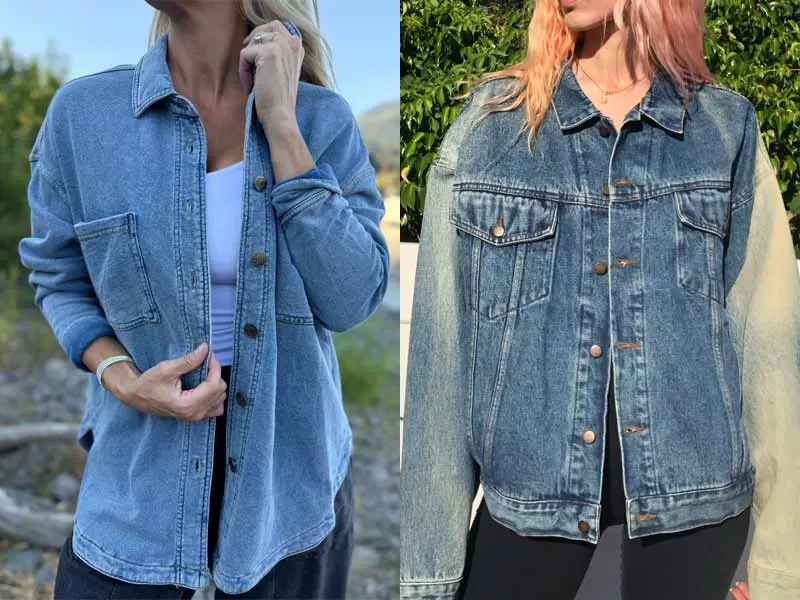
A denim shacket and a denim jacket can look almost interchangeable on a product page. Both may have a point collar, metal buttons, chest pockets, indigo twill and visible topstitching. Put them on, however, and the difference is easier to feel. One may move like a substantial shirt and sit comfortably over a tee or knit; the other may hold its shoulder line, frame the torso and behave more like true outerwear. That distinction matters to consumers choosing a layer, but it matters even more to a brand developing the garment because a small change in fabric weight, shoulder ease, hem construction or wash softness can move the same concept from overshirt territory into jacket territory. The useful comparison is therefore not a battle over names. It is a practical look at how each garment is built, how it is meant to be worn and which technical decisions create the finished experience.
A denim shacket is usually a shirt-jacket hybrid with a softer, roomier construction, while a denim jacket is typically more structured and designed as outerwear. The difference comes from the combined effect of pattern shape, fabric weight, seam construction, pockets, hardware, hem treatment, lining and intended layering. Neither label has an absolute technical boundary, so the better choice depends on silhouette, climate, styling and post-wash performance.
That last point explains why two garments that look nearly identical in a sketch can end up feeling completely different in production. A 9 oz soft-washed overshirt with a dropped shoulder and curved hem will not behave like a 12.5 oz rigid trucker with a structured bottom band, even if both use the same indigo shade and metal closures. Once fabric, pattern, wash and construction are viewed together, the category becomes much easier to understand, and the same framework also helps designers, product developers and sourcing teams write clearer briefs and avoid costly sample revisions.
What Is a Denim Shacket?
A denim shacket is a shirt-jacket hybrid designed to work as a light outer layer. It usually keeps shirt-like elements such as a point collar, button front, cuffs and patch pockets, but adds more body ease, heavier denim and enough structure for layering. The category is flexible, so silhouette, fabric weight, construction and finished handfeel matter more than the product name alone.
Is a Denim Shacket a Shirt or Jacket?
A shacket sits between a denim shirt and a conventional denim jacket rather than belonging perfectly to either category. From the shirt side, it often borrows a point collar, cuffed sleeves, a back yoke, a relatively simple front and a straight or curved hem. From the jacket side, it gains enough fabric substance, body ease, pocket capacity and durability to be worn as an outer layer. That hybrid position is useful because it gives designers more freedom, but it also creates naming inconsistency across retailers. One brand may call a garment a shacket while another calls a very similar piece an overshirt or lightweight jacket.
The most reliable way to classify the product is to ask how it is meant to behave after washing and during wear. If it drapes easily, layers over a tee or light knit and feels comfortable indoors, it is functioning like a shacket. If it depends on firmer paneling, a stronger shoulder line, reinforced hem structure and more substantial hardware to hold an outerwear silhouette, it is moving toward denim-jacket territory. During development, that functional description is far more useful than simply writing “make it like a shacket” in a brief.
Is a Denim Shacket the Same as an Overshirt?
In commercial fashion language, shacket, overshirt and shirt jacket overlap heavily. An overshirt usually leans closer to a shirt in construction and handfeel, while shacket often suggests a slightly more substantial crossover piece with larger pockets or greater layering ease. These are tendencies rather than standardized technical rules. For a brand, the label should therefore follow the finished garment experience. A soft, unlined denim piece with shirt cuffs and a curved hem naturally reads as an overshirt; a roomier utility style with more body and pocket structure may read more clearly as a shacket.
The naming decision also affects expectation. A shopper searching for an overshirt may expect something relatively soft, light and easy to wear indoors, while a denim-jacket shopper may expect firmer structure and greater protection. When the product name promises one experience and the garment delivers another, even technically sound manufacturing can feel disappointing. Product teams should lock the commercial name only after the post-wash sample is approved, because wash and finishing can move the same base fabric noticeably toward a softer or more structured result.
How Does a Denim Shacket Fit?
Most denim shackets use regular, relaxed or oversized fits because the garment is intended to accommodate another layer. Extra room should not come from chest width alone. Shoulder position, armhole depth, bicep width, sleeve shape, cuff opening, body length and hem width need to work together. A dropped shoulder can create an easy, modern look, but it also changes sleeve balance. If the shoulder is extended without adjusting the sleeve head and upper-arm width, the garment can bunch, twist or feel restrictive despite looking wide on a measurement chart.
Fit testing should also reflect how the customer will really wear the product. A shacket approved over a thin camisole may become tight when it is worn over a sweatshirt, while a pattern built around an overly thick underlayer may look shapeless over a T-shirt. The practical solution is to define the intended layering piece at the sample stage and fit the garment in that condition. For women’s, men’s and unisex programs, the same logic applies even though proportion changes: layering ease should be engineered into shoulder, back and sleeve movement rather than added as uncontrolled overall volume.
Is a Denim Shacket Lightweight?
Many denim shackets are light to medium weight, but there is no fixed ounce limit for the category. JEANZIO’s working denim framework uses about 8-13 oz as a common development zone. Within that range, 8-9 oz tends to suit shirt-like and warm-weather products, 9-10.5 oz offers a light-to-medium balance, 10.5-12 oz provides broader structure, and 12-13 oz moves toward firmer vintage or jacket-oriented constructions. These are development ranges, not universal category definitions.
Weight also needs to be read together with thickness, weave density, yarn character, fiber composition and wash. Two fabrics labeled 10 oz can feel very different once one is enzyme washed and softened while the other stays dry and compact. A premium lightweight denim can be more suitable for a refined shacket than a heavier fabric that becomes stiff at cuffs and pockets. The better sequence is to define the silhouette and target handfeel first, shortlist materials that can deliver that result, then confirm the choice on a washed garment rather than on a swatch alone.
What Is a Denim Jacket?
A denim jacket is an outerwear garment built around a more deliberate structure than a denim shirt or shacket. It may be fitted, cropped, oversized, boxy or utility-inspired, but its pattern, fabric and construction are generally intended to preserve a recognizable outerwear silhouette after washing and repeated wear. The category is broad, yet structure and shape retention remain central to how it performs.

What Defines a Denim Jacket?
A denim jacket is best understood as a construction system, not as a garment with one mandatory detail. A point collar does not automatically make a jacket, and metal buttons do not either. The product becomes jacket-like when shoulder geometry, body panels, sleeve shape, front opening, pockets, hem structure and reinforcement work together to create a stable outerwear form. Classic trucker styles often use multiple front panels, chest pockets, prominent topstitching and a structured bottom band, while chore and utility jackets may use simpler body panels but larger functional pockets and straighter proportions.
JEANZIO’s product taxonomy covers trucker, cropped, oversized, fitted, chore, utility and boxy denim jackets, with technical attention to collar shape, shoulder line, armhole, pocket position, front placket, hardware and post-wash dimensions. That list is more useful than a generic description because it shows where quality is actually won or lost. Firmer denim exposes small balance problems quickly: an incorrect shoulder line produces drag, a poorly shaped sleeve twists, and an unstable placket can ripple after wash. A convincing jacket is therefore the result of several aligned decisions rather than one recognizable feature.
Which Denim Jacket Styles Are Common?
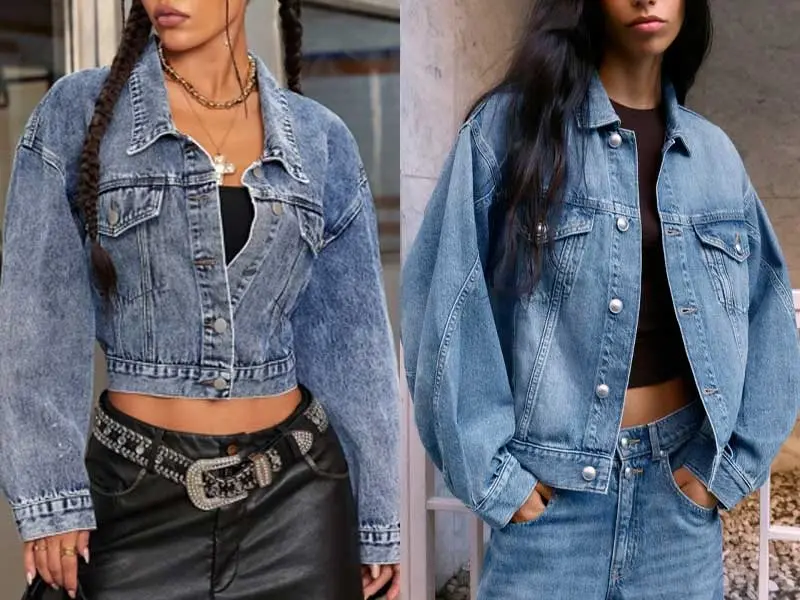
The trucker jacket remains the most recognizable archetype, but modern collections extend far beyond it. Cropped jackets work especially well with high-rise bottoms because the shorter body changes the proportion of the whole outfit. Oversized jackets support casual, streetwear and unisex positioning, while fitted styles emphasize a cleaner torso and may rely on darts, shaped side seams or panel lines. Boxy jackets use controlled width and shorter length to create a deliberate rectangular silhouette, and chore or utility jackets borrow from workwear through larger pockets, durable stitching and a straighter body.
These categories cannot all be developed from one block by simply adding or subtracting centimeters. A true oversized jacket changes shoulder, chest, sleeve and hem relationships together; a cropped jacket must rebalance pocket scale and body length; a fitted style has different movement requirements from a boxy workwear piece. For collection development, the jacket block should therefore be chosen according to the intended silhouette, then tested with the final denim and wash. If a jacket is part of a matching set, garment-level wash approval is also important because a jacket and jeans made from the same fabric can still show different abrasion and shade effects after processing.
How Does a Denim Jacket Hold Its Shape?
Shape retention comes from the interaction of fabric stiffness, pattern geometry, seam placement, topstitching, reinforcement and post-wash finishing. Rigid or low-stretch cotton denim is often effective when the design calls for a crisp collar, stable panels and visible structure. Cotton-rich rigid fabric also produces the authentic fading and seam contrast associated with classic denim. The trade-off is that firmer materials make pattern errors more visible and can restrict movement at the upper back, armhole and elbow when insufficient ease is built into the garment.
Heavier fabric alone does not create a better jacket. Thickness can become a liability where several layers meet at cuffs, plackets, pocket corners or bottom bands, so seam allowances and internal construction need to control bulk. Topstitching adds stability and visual definition, but it also magnifies puckering when fabric and thread tension are not balanced. Most importantly, the jacket should be judged after the intended commercial wash. Enzyme treatment, softening, bleaching and other finishing steps can change handfeel, body length and panel behavior enough to alter the silhouette that was approved before washing.
How Do Jacket Details Affect Performance?
Details that look decorative in a sketch often carry functional consequences in production. A large chest pocket adds fabric layers and weight to the front panel; a snap closure changes reinforcement needs compared with a lightweight shirt button; a wide cuff can become bulky when dense denim is folded several times. Trucker-style waistband sections help frame the body, while a clean straight hem creates a looser chore or utility impression. Even topstitch width and stitch density influence how edges hold after washing, especially where the design expects crisp geometric lines.
A strong development brief therefore connects each detail to its intended job. If a pocket is functional, capacity and reinforcement matter. If it is visual, scale and placement matter more. If the jacket must feel soft despite rigid denim, the wash route becomes part of the construction solution. This is also where experienced pattern and sample teams add value: they can identify when a detail that looks simple on a reference image will create seam bulk, distortion or poor mobility in the chosen material, and they can propose alternatives before those issues reach bulk production.
What Are the Key Differences Between a Denim Shacket and Denim Jacket?
The main difference is functional structure. A denim shacket normally behaves like a substantial shirt that can be layered, while a denim jacket behaves like outerwear designed to hold a clearer shape. Fit, fabric, hem, pockets, reinforcement, hardware and wash all contribute, so no single feature can classify every garment correctly. The two categories overlap most strongly in medium-weight, unlined utility styles.

| Product factor | Denim shacket | Denim jacket | Practical effect |
| Primary role | Light outer layer | Outerwear | Changes pattern ease and construction |
| Typical fit | Regular to relaxed | Fitted to oversized | Layering room varies by style |
| Fabric direction | Light to medium | Medium to firm | Affects drape and shape retention |
| Common working weight | About 8-11 oz | About 10.5-13 oz | Ranges overlap; not a fixed rule |
| Hem | Straight or shirt-like curved | Straight, banded or structured | Strong visual category cue |
| Cuff | Shirt cuff common | Jacket cuff or tab common | Changes sleeve bulk and handling |
| Pockets | Patch/chest utility | Chest, welt, side or patch | Affects function and seam bulk |
| Lining | Often unlined | Unlined or lined | Changes warmth and weight |
| Wash goal | Soft, easy handfeel common | Clean to vintage or structured | Final wash can shift category feel |
How Do Fit and Length Differ?
Shackets tend to prioritize layering ease, so the body is often straighter, the shoulder may be natural or dropped, and the armhole is usually forgiving enough to accommodate another garment underneath. Denim jackets can also be oversized, but their volume is more often organized around a jacket block so the garment retains a stronger outerwear identity. Length reinforces the difference. Below-hip bodies with shirt cuffs and large patch pockets often read as shackets, while cropped or waist-length bodies with structured hems and traditional trucker paneling read more clearly as jackets.
The important point is that fit words are not product categories. Oversized does not automatically mean shacket, and fitted does not automatically mean jacket. A fitted shacket and an extremely oversized trucker are both commercially valid. Product teams get better results by defining relationships among shoulder width, chest ease, body length, sleeve width and hem width. When only one measurement is enlarged, the garment can look accidentally big rather than intentionally relaxed. When several points are balanced together, the silhouette remains controlled even at generous volumes and across an extended size range.
How Do Collars, Hems and Cuffs Differ?
Both categories can use a point collar, so collar shape by itself is a weak classifier. The surrounding construction provides more evidence. Shackets often borrow directly from shirts through a collar stand, curved hem, side slit or buttoned shirt cuff. Traditional trucker jackets may use a flatter collar, heavier front construction and a separate bottom band, while chore jackets can keep a straight hem but retain a more substantial outerwear balance. These details communicate whether the product is intended to feel easy and shirt-like or framed and jacket-like.
The same details affect manufacturability. A curved hem in firm denim must be turned and pressed cleanly without creating distortion. A thick cuff can become bulky where multiple seam allowances overlap. A very soft fabric may cause a wide jacket cuff or bottom band to collapse after wash. For this reason, styling decisions should not be finalized independently from material choice. A coherent garment uses a collar, cuff and hem construction that the chosen denim can support without excessive thickness, wrinkling or instability after repeated washing and wear.
Do Pockets and Hardware Differ?
Shackets commonly use patch pockets because they suit shirt-like construction and utility styling. Two chest pockets are typical, and longer designs may add large lower pockets. Denim jackets can use patch pockets as well, but they may combine them with welt pockets, side-entry pockets or more engineered chest constructions. Hardware follows the same logic. Tack buttons create a classic denim signal, snaps push the product toward western or utility styling, and conventional shirt buttons make the garment feel more like an overshirt. No option is automatically better; each should match the intended identity and use.
Pocket and closure choices also change production risk. Dense denim can become very bulky where pockets, flaps, plackets and reinforcement stack together, while lightweight denim can pucker around edges if sewing and pressing are not controlled. Functional lower pockets may need bartacks or other stress reinforcement, whereas purely visual chest pockets may prioritize symmetry and placement. For reliable bulk production, pocket dimensions, stitch distances, button positions and reinforcement points should be frozen in the approved sample rather than left to visual interpretation from a reference image.
Is a Denim Shacket Less Structured?
Usually, but structure exists on a continuum. A soft 8.5 oz shirt-jacket and a firm 13 oz trucker sit at obvious opposite ends; the middle is less clear. A 10.5 oz rigid overshirt with large utility pockets may feel more substantial than an 11.5 oz jacket that has been heavily enzyme washed and softened. Structure is created by weight, thickness, weave density, pattern geometry, reinforcement, pocket layering, stitching, hem design and finishing, so category names alone cannot predict how a garment will behave.
This is why development feedback should be specific. Instead of saying “make it more like a shacket,” a product team might ask for a softer handfeel, more shoulder ease, a straighter body, a curved hem and reduced internal reinforcement. Instead of asking for “more jacket structure,” it could specify a firmer base fabric, more defined shoulder balance, a structured bottom band and cleaner edge retention after wash. Those instructions can be acted on by pattern, sourcing, sample and wash teams, while a broad product label cannot.
Which Denim Fabric and Weight Work Best?
The best denim depends on the silhouette and finished handfeel rather than the category name. Shackets usually perform well in lighter, softer fabrics, while jackets often benefit from medium or structured rigid denim. A useful working range is about 8-13 oz, but composition, weave, thickness, stretch, shrinkage and wash response can make two fabrics with the same ounce weight behave very differently.

| Denim weight | Typical character | Shacket use | Jacket use | Key development risk |
| 8-9 oz | Light, flexible | Strong for shirt-like styles | Limited for firm structure | Puckering, low shape retention |
| 9-10.5 oz | Light-medium | Core transitional range | Soft casual jackets | Wash can change drape strongly |
| 10.5-12 oz | Medium | Structured shackets | Broad jacket range | Bulk at pockets and plackets |
| 12-13 oz | Firm, substantial | Workwear-oriented only | Trucker, utility, vintage | Stiffness, seam bulk, shrinkage |
Is Rigid Denim Better for Jackets?
Rigid denim is often an excellent choice for trucker, boxy, chore and workwear-inspired jackets because it holds shape and develops authentic fading. A good rigid fabric supports defined collars, clean pocket edges, firm front panels and visible topstitching. During wash, it can also create attractive contrast around seams and high-contact areas. That does not make rigid denim universally superior. A fashion jacket designed to feel soft and slouchy may perform better in a lighter or more pliable fabric, while a dry 13 oz rigid construction can feel unnecessarily restrictive if the pattern is not built for movement.
Cotton-rich rigid denim also brings risks that need to be managed rather than ignored. Shrinkage, skew and initial stiffness can affect fit and appearance, especially when the style has long sleeves, a close cuff or a structured placket. The useful rule is to let the silhouette lead the material decision. If the goal is crisp geometry and vintage character, rigid denim is a strong starting point. If the goal is comfort and relaxed drape, a softer rigid, cotton-blend or lighter-weight construction may create a better finished product even though it looks less impressive as an isolated fabric swatch.
Which Denim Weight Works for Shackets?
For many commercial shackets, approximately 8-11 oz is a practical starting zone, while heavier options can be used for workwear or colder-season concepts. Around 8-9 oz, denim behaves more like a substantial shirt and works well for warmer weather or soft women’s styles. The 9-10.5 oz area gives more body while remaining comfortable for layering. Around 10.5-11 oz, the garment begins to feel more jacket-like depending on weave and finishing, yet it can still work as a structured overshirt if the pattern and wash remain shirt-led.
The post-wash sample should make the final decision. A softened 11 oz fabric can feel easier than a dry, compact 9.5 oz fabric, and two fabrics with the same listed ounce weight can differ in thickness, drape and seam bulk. A useful material brief therefore includes weight, fiber composition, stretch category, target handfeel, target wash and intended silhouette. That information helps sourcing teams compare fabrics on the basis of finished performance rather than choosing the closest number on a spec sheet.
How Does Wash Change Structure and Handfeel?
Wash can completely change the character of denim outerwear. Desizing and enzyme treatment may soften a fabric that initially feels dry and rigid, while vintage washing can increase surface contrast and make seams more pronounced. Bleaching changes color dramatically and can also affect strength if the process is too aggressive. Softener alters the tactile experience again. For meaningful approvals, handfeel is better described with practical words such as dry, crisp, smooth, compact, soft or slouchy than with vague marketing language such as “premium feel.”
Bulk consistency matters just as much as development appearance. Denim shade and handfeel can shift with fabric lot, machine load, chemistry, time and temperature, so one attractive wash sample is not yet a repeatable production standard. JEANZIO’s quality approach checks shade, wash effect, handfeel, shrinkage, twist and visible damage after washing, then uses approved references and shade grouping to keep natural variation inside a controlled window. The goal is not to claim zero variation; it is to make variation visible, traceable and commercially manageable.
Do Stretch Blends Work for Shackets and Jackets?
Stretch denim can work well when it solves a real fit or comfort problem. Fitted women’s jackets, narrow sleeves and close-body shackets may benefit from comfort stretch because small amounts of extension improve mobility without changing the visual identity of the fabric. High stretch is usually less suitable for boxy, trucker or workwear silhouettes that depend on crisp edges and structural presence. As stretch rises, the garment may become softer, less stable and more prone to growth unless the fabric has strong recovery.
Recovery is therefore as important as extension. A fabric that stretches easily but does not return well can create bagging at elbows, cuffs or body areas after wear. Wash may also change elastic performance, particularly when heat, chemistry or mechanical abrasion is involved. The safe development route is to test the chosen fabric after the target wash and build the pattern specifically around its behavior. Replacing a rigid fabric with stretch denim late in development without revisiting ease and pattern balance is rarely a reliable shortcut.
Which Is Better for Layering and Different Seasons?
A denim shacket is usually more flexible for light layering because it tends to be softer, roomier and easier to wear indoors, while a denim jacket provides more outerwear structure and can suit cooler conditions when heavier fabric or lining is used. Seasonality depends more on fabric weight, length, density, fit and layering capacity than on whether the product is called a shacket or jacket.

Which Is Better for Spring and Fall?
Both products are strong transitional-season choices, but they solve slightly different needs. A lightweight shacket can be worn open over a T-shirt in mild weather, closed over a knit when temperatures fall and placed under a coat later in the season. That flexibility makes it especially useful when customers move between indoor and outdoor environments. A denim jacket creates a stronger outerwear statement and usually holds its shape better, which suits styling that depends on a clear jacket silhouette rather than on the relaxed feel of a substantial shirt.
Fabric weight should follow the target market rather than a global season label. In JEANZIO’s working map, roughly 8-9.5 oz leans toward lightweight and warmer-season use, 9.5-11 oz covers a strong cross-season zone, 11-12 oz works across more year-round and cooler applications, and 12-13 oz moves toward firmer vintage and jacket-oriented products. Climate still changes the interpretation. An 11 oz unlined jacket may serve as winter outerwear in a warm region but only as a spring or early-fall layer in a colder market.
Which Is Warmer, a Shacket or Denim Jacket?
A denim jacket is often warmer, but the product name alone cannot answer the question. Warmth depends on fabric mass, weave density, lining, garment length, wind resistance, body ease and what is worn underneath. A long 11 oz shacket over a sweatshirt can feel warmer than a cropped unlined 10 oz trucker, while a lined jacket can outperform both. The amount of air trapped between layers also matters, so a slightly roomier garment may feel more insulating than a very fitted one made from heavier fabric.
For product development, “warm” should be translated into a real use case. Will the customer wear the piece over only a T-shirt, or over a knit and hoodie? Is it intended for mild transitional weather, or to replace a lightweight coat? Those answers influence sleeve width, armhole depth, body ease and length as much as fabric weight. Simply moving from 10 oz to 13 oz can increase stiffness and seam bulk without delivering a proportionate improvement in comfort. If meaningful warmth is required, lining and wind resistance may be more effective tools than denim weight alone.
Which Is Better for Layering?
Shackets usually have the advantage because layering is part of their core design logic. Good layering, however, is an engineering problem rather than an oversized label. The shoulder must allow forward movement, the armhole must accommodate the base layer without pulling, bicep width needs room for two fabric layers, and the cuff cannot become uncomfortable when sleeves overlap. Body ease should provide space without making the garment look empty. When these areas are balanced, the garment feels relaxed because it is designed that way, not because every dimension was simply enlarged.
A jacket can also be developed for layering, particularly in relaxed and oversized fits, but the designer may want to retain a stronger shoulder or hem shape. The most reliable fit test uses the intended underlayer. A shacket that is approved over a thin fitting top can fail once a customer adds a sweatshirt, while a jacket developed around a heavy hoodie may look oversized when worn over a tee. Sample fitting should therefore reproduce the most important real-world styling condition before the pattern is frozen.
How Should Each Style Fit?
There is no universal correct fit for either category. Shackets can be regular, relaxed or oversized, and denim jackets range from sharply fitted to deliberately huge. The more useful approach is to define silhouette through relationships. In a relaxed shacket, shoulder width, chest ease and sleeve volume should expand together. In a cropped jacket, shorter body length has to remain balanced with pocket scale and sleeve volume. In a boxy style, width should look intentional rather than like a standard jacket that was graded several sizes too large.
Upper-body denim usually deserves close attention at the shoulder, across-back, chest, armhole, bicep, sleeve length, body length, hem and pocket position. These relationships also need to survive grading. Larger sizes cannot simply receive equal increases at every point because excessive shoulder growth, pocket drift or uncontrolled body length can change the original design language. A strong size range keeps the same visual logic from the base size upward, while still adding the movement and ease required for different bodies.
How Do Brands Develop Denim Shackets and Jackets for Production?
Brands should develop denim shackets and jackets by locking silhouette, fabric, wash, construction, dimensions and trims through a staged sample process before bulk cutting. Denim changes after washing, so fit and measurements need approval in the finished condition. A disciplined process connects fabric testing, pattern compensation, sample revisions, wash approval, PP confirmation and bulk quality control instead of treating them as separate tasks.
| Development stage | Main check | Typical output |
| Fabric selection | Weight, composition, handfeel, shrinkage risk | Selected base fabric |
| Shrinkage test | Length and width change after target process | Shrinkage data |
| Pattern adjustment | Compensate critical dimensions | Revised pattern |
| Sample wash | Fit, shade, handfeel, twist | Washed sample |
| Measurement review | Compare post-wash POM with spec | Measurement report |
| Revision | Correct pattern or construction issues | Revised sample |
| PP approval | Freeze pattern, wash, trims, workmanship | Approved PP reference |
| Bulk control | Monitor measurements, wash lots, QC gates | Production records |
Which Measurements Need the Most Control?
Upper-body denim demands a different measurement focus from jeans. Shoulder and armhole errors can make an otherwise correctly sized garment uncomfortable, while pocket position and body length can change visual proportion immediately. Common control points include shoulder width, across-back, chest width, waist where shaped, hem or sweep, front and back body length, armhole depth, sleeve length, bicep, cuff opening, collar dimensions, pocket size and position, and front placket width. The most important point is that these measurements interact rather than working independently.
If shoulder width changes, sleeve length and sleeve-head balance may need adjustment. A deeper armhole can require more bicep room. A cropped body can make an unchanged chest pocket suddenly look oversized. JEANZIO’s pattern approach links pattern balance, POM measurements, tolerance, grading, shrinkage compensation, approved patterns and bulk measurement control in one system. For production, the specification should also identify critical POMs so inline teams know which dimensions have the greatest effect on fit, movement and appearance rather than treating every measurement as equally sensitive.
How Does Shrinkage Affect the Pattern?
Shrinkage should be treated as a pattern-development input before bulk release. Denim can change in both length and width after washing, and different garment areas may respond differently because of grain direction, seam structure, interfacing and layer count. A single blanket enlargement percentage is therefore not always sufficient. The development team needs actual fabric behavior from the intended wash, then uses that information to compensate critical dimensions and verify the result on a washed sample before approving the production pattern.
The practical sequence is fabric selection, shrinkage testing, pattern compensation, sample wash, post-wash measurement, pattern correction, PP approval and bulk monitoring. If a substitute fabric is introduced, it should be rechecked for fit, wash, shrinkage and handfeel even when its composition and ounce weight look similar. This matters especially on jackets because dimensional changes alter visual relationships: body shortening can move pockets too low visually, cuff shrinkage can restrict closure, and uneven placket behavior can create rippling that was not present before washing.
How Do Sample and Wash Approvals Work?
A disciplined approval process freezes decisions in stages. The first sample establishes silhouette and basic construction. Revisions correct fit, pocket placement, collar shape and workmanship. Wash development then defines the finished shade, contrast, abrasion, handfeel and dimensional behavior. The PP sample should bring those decisions together as one production reference. At JEANZIO, the development structure includes 3 designers, 6 pattern makers and 15 sample makers, supporting roughly 60-90 new styles per month across different denim categories and complexity levels.
Typical first samples are developed in about 7-15 days, while revisions and PP samples generally require about 7-10 days depending on fabric availability, wash and complexity. Those are planning ranges rather than unconditional promises. Once bulk starts, approval continues through process control: incoming material checks, cutting inspection, inline sewing checks, pre-wash review, first-bulk and post-wash evaluation, 100% finished-garment inspection, AQL 2.5 or a customer-specific final audit, and packing verification. Each gate is designed to catch a different type of error before it becomes more expensive to correct.
What Should Brands Put in a Tech Pack?
A useful Tech Pack removes the ambiguities that affect fit, cost and repeatability. For a denim shacket or jacket, it should include a style overview, front and back technical drawings, bill of materials, construction notes, POM measurement chart, base size, grading direction, fabric specification, wash reference, thread details, button or snap specification, pocket dimensions and positions, labels, artwork where relevant, packaging instructions and any critical tolerance requirements. The objective is not paperwork for its own sake; it is giving every team one approved source of truth.
Not every project begins with a complete Tech Pack. A reference garment, sketch or clear product image can also start development, but the missing decisions still need to be converted into an approved pattern, measured sample, confirmed material, wash standard and construction specification before bulk production. JEANZIO commonly structures commercial development around roughly 300-500 pieces per style and color, with actual MOQ shaped by fabric, wash, trims and SKU structure. When a concept is still incomplete, a development review can therefore be more useful than asking for a price before the technical inputs are comparable.
Conclusion
The useful answer to denim shacket versus denim jacket is not that one is better. They are different tools for different product experiences. A shacket usually wins when softness, easy layering and shirt-like styling are central; a jacket wins when stronger structure, outerwear identity and shape retention matter more. The boundary is intentionally flexible, which is why product teams should define the garment through measurable decisions rather than relying on the name alone. Fabric weight, shoulder balance, armhole, sleeve volume, pockets, hardware, hem, wash and post-wash dimensions all shape how the final piece feels. For brands developing a new style, the most reliable route is to approve those variables as one connected system. That approach produces a clearer brief, fewer avoidable revisions and a product that is easier to reproduce when the first sample becomes a real production order.
Frequently Asked Questions
What is the main difference between a denim shacket and a denim jacket?
The main difference is how the garment is intended to function. A denim shacket usually behaves like a substantial shirt that can be worn as a light layer, so it often has softer construction, more layering ease and shirt-like cuffs or hems. A denim jacket is generally designed as outerwear and places more emphasis on shape retention, reinforced construction and a deliberate jacket silhouette. Fabric weight overlaps, so the name alone is not enough to classify every style.
Is a denim shacket the same as a denim overshirt?
The terms are often used for very similar products, and there is no universal technical rule separating them. An overshirt usually leans closer to a shirt in weight, handfeel and construction, while a shacket often suggests more outerwear substance or utility details. In practice, brands should choose the term that best matches the finished garment. A soft unlined piece with shirt cuffs may read as an overshirt, while a roomier, more substantial utility layer may read as a shacket.
What denim weight is best for a shacket?
A practical starting range for many shackets is about 8-11 oz. Fabrics around 8-9 oz work well for soft, shirt-like or warmer-season styles, while 9-10.5 oz provides more body without becoming too stiff. Around 10.5-11 oz, the garment can feel more structured and may move closer to jacket territory depending on weave and wash. The finished post-wash handfeel matters more than the ounce figure alone, so sample evaluation is essential.
Is a denim jacket warmer than a denim shacket?
Often, but not always. A jacket may use heavier denim, lining or a denser construction, which can make it warmer. However, garment length, body ease, wind resistance and the layers worn underneath also matter. A long shacket worn over a sweatshirt can be warmer than a cropped unlined jacket made from similar denim. For product development, warmth is better specified through the intended climate, underlayer and wearing situation instead of assuming that heavier denim automatically delivers better cold-weather performance.
Can rigid denim be used for a shacket?
Yes. Rigid denim can work very well for a shacket when the design needs a crisp workwear or utility character. The pattern and wash need to compensate for the fact that rigid denim offers less give and may shrink or soften significantly during finishing. A lighter rigid fabric can create a clean structured overshirt, while a heavier dry rigid may feel more like a jacket. The category depends on the whole garment, including fit, hem, pockets and final handfeel, not on stretch content alone.
What should a brand send to develop a custom denim shacket or jacket?
The strongest starting point is a Tech Pack containing technical drawings, measurements, fabric direction, wash reference, construction details, trims, labels and packaging requirements. If the Tech Pack is incomplete, a reference garment, sketch or clear product image can still begin development, but missing decisions need to be resolved through pattern work, sampling and approvals before bulk production. Sharing target quantity, market, launch timing and desired handfeel early also helps the development team recommend realistic fabric, wash and construction routes.