跳到内容

Long denim shorts can look deceptively simple on a line sheet. Change the inseam by an inch, add a little more thigh room, widen the hem, or swap a clean turn-up for a washed raw edge, and the same starting idea can move from a polished Bermuda short to a street-led jort. That is also why the two names increasingly overlap in stores, trend reports, and product development conversations. The label alone does not tell you enough about the garment.
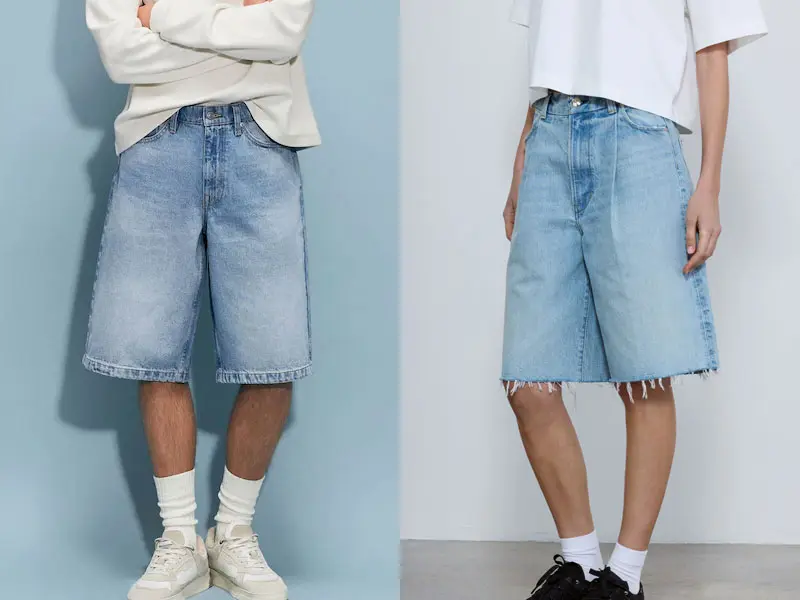
Denim jorts are generally denim shorts with a relaxed, often roomy silhouette, while denim Bermuda shorts are identified more strongly by their longer, knee-area proportion. The categories can overlap, so the practical difference is usually found in the relationship between rise, hip and thigh ease, inseam, leg opening, fabric structure, wash, and hem treatment rather than in one universal measurement or naming rule.
For brands developing a seasonal denim range, that distinction has real consequences. A product that looks strong in a reference image can lose its intended attitude when the fabric is too soft, the knee position shifts after washing, or the hem opening grows too aggressively during grading. The interesting question is therefore not simply what to call the short. It is how to engineer the exact silhouette the customer should see, wear, reorder, and recognize across a full production run.
What Are Denim Jorts and Denim Bermuda Shorts?
Denim jorts and denim Bermuda shorts are overlapping long-short categories rather than completely separate garments. Jorts are defined mainly by their denim identity and commonly relaxed attitude, while Bermuda shorts are defined more strongly by a longer proportion that finishes around the knee. A loose, knee-length denim short can fit both descriptions, so fit, finishing, fabric, and merchandising context usually determine which name feels more accurate.
What Are Denim Jorts?
The word “jorts” comes from “jeans” and “shorts,” but current product use often means more than any short made from denim. Modern jorts commonly have enough length and volume to create a visible silhouette: a relaxed seat, a roomy thigh, and a straight or wide leg opening that usually finishes somewhere from the lower thigh to the knee area. The strongest examples look intentionally proportioned, not like ordinary jeans that were simply cut shorter.
From a development standpoint, jorts are controlled through the same measurements that shape a pair of jeans, but the shorter leg makes proportion errors easier to notice. Front rise, back rise, hip ease, thigh width, inseam, outseam, leg opening, pocket scale, and pocket placement all contribute to whether the garment feels balanced. A very deep rise with excessive seat volume can create collapse around the crotch, while a wide hem attached to a comparatively narrow thigh can turn a desired straight shape into an unintended flare.
Fabric and finishing then reinforce the identity. Cotton-rich rigid denim helps a wide silhouette hold its shape, while softer lightweight denim creates more movement. Raw hems, faded indigo, grinding, whiskering, carpenter details, oversized pockets, and worn-in surfaces push the garment toward streetwear or vintage casual. Cleaner hems and darker washes can make the same general jort block look more refined, which is useful when a brand wants the volume of a jort without an aggressively distressed appearance.
What Are Denim Bermuda Shorts?
Denim Bermuda shorts are best understood as long denim shorts whose visual proportion is organized around the knee. The defining feature is therefore more strongly connected to finished length than to one particular fit. A Bermuda can be straight, fitted through the hip, moderately relaxed, pleated, utility-inspired, or even oversized. Two brands can request “denim Bermuda shorts” and expect very different products, which is why the name should never replace an actual fit specification.
A cleaner women’s Bermuda might use a high or mid rise, controlled hip ease, a straight leg, a finished hem, and a dark rinse. A fashion-led version might sit lower on the waist, carry more volume through the thigh, and use a washed surface with a raw edge. Both remain recognizable as Bermudas because the hem position stays close to the knee, but their product identities, styling possibilities, and manufacturing risks are not the same.
For reliable development, the brief should define the intended hem position, inseam and outseam, front and back rise, full hip, thigh, leg opening, waistband construction, pocket proportions, fabric weight, stretch level, and finished wash. Reference images communicate mood, but measurements and an approved physical sample communicate the product. This is especially important in long shorts because small changes around the knee can alter the entire visual balance.
Are Denim Bermuda Shorts a Type of Jorts?
Many denim Bermuda shorts can reasonably be described as jorts, but not every jort is a Bermuda short. A useful way to understand the relationship is that “jorts” is primarily a denim-based identity, while “Bermuda” is primarily a length-and-proportion identity. When a denim short is both loose and knee-length, the two terms naturally overlap, and retailers may use either name depending on trend language, brand positioning, and the customer they want to reach.
That overlap is useful for product teams because it forces a distinction between commercial naming and technical development. A youth-focused label may call a wide knee-length style “baggy jorts” because the term carries streetwear energy. A cleaner contemporary brand could take a related base pattern, narrow the hem slightly, remove heavy abrasion, add a conventional finished edge, and merchandise it as a “denim Bermuda short.” The product architecture changes by degrees rather than by crossing a strict category boundary.
The practical rule is simple: define the finished silhouette first and choose the name second. Decide where the hem should sit, how much ease the hip and thigh should carry, how wide the leg opening should appear from the front and side, how structured the fabric should feel, and whether the surface should look clean or worn. Once those decisions are measurable, the product name becomes a marketing choice instead of a source of technical ambiguity.
What Is the Difference in Length and Fit?
The clearest difference is that Bermuda shorts are more strongly defined by knee-area length, while modern jorts are more strongly associated with relaxed or oversized denim proportions. Length alone cannot separate them because rise, body height, thigh ease, leg opening, and wash shrinkage affect where the hem actually sits. The most reliable comparison therefore looks at several measurements and the finished silhouette together, not one inseam number.

How Does the Length Compare?
Long denim shorts are especially sensitive to small changes in length because the hem sits close to the knee, a strong visual reference point on the body. Moving a hem by only 1 to 2 inches can make the same pattern look more conventional, more skate-inspired, or more tailored. That is why a design team should define both the numeric garment length and the intended visual position on the fit model rather than using an inseam value in isolation.
A 10-inch inseam, for example, will not land in exactly the same place on every pattern. Low-rise and high-rise blocks distribute vertical length differently, while crotch depth, body height, and grading influence the result again. For women’s styles, a high-rise Bermuda with a 10-inch inseam may look more elongated through the torso and leg than a low-rise jort carrying the same inseam. The finished wash can also reduce length enough to make an approved pre-wash proportion visibly different afterward.
| Development Point | Modern Denim Jorts | Denim Bermuda Shorts | Practical Check |
| Typical adult inseam | About 7-13 in | About 9-13 in | Confirm on intended fit model |
| Hem position | Lower thigh to slightly below knee | Usually around the knee | Check front, side, and back views |
| Rise options | Low, mid, or high | Commonly mid or high, but variable | Review seated comfort |
| Leg shape | Straight to very wide | Straight to moderately wide | Compare thigh-to-hem balance |
| Length sensitivity | High | Very high | Recheck graded sizes after wash |
These ranges are useful starting references rather than universal industry standards. A brand’s target customer, fit model, size range, and intended styling should override a generic number. The most dependable approval method combines measurement data with on-body photographs and post-wash samples, because the customer ultimately sees where the hem sits on a person, not the inseam value printed on a specification sheet.
How Does the Fit Compare?
Jorts usually depend on visible ease. The seat should not feel strained, the thigh should hang away from the body, and the leg opening often reinforces a straight or boxy outline. Simply sizing up a conventional short does not create the same result because the waist, crotch, pocket position, yoke, and rise may become disproportionately large. Intentional oversized fit requires a balanced pattern rather than a larger label size.
Denim Bermuda shorts allow a broader fit spectrum. They can be relaxed, but they can also sit closer through the hip and upper thigh while maintaining enough ease to walk and sit comfortably. This is one reason a dark-indigo Bermuda can work in a cleaner contemporary collection while a heavily faded, roomy jort reads more immediately as streetwear. The difference is often not length at all, but how much volume is distributed between waist, hip, thigh, and hem.
For fit review, four measurements deserve particular attention: full hip, thigh, front rise, and leg opening. Back rise and crotch extension are equally important when the product pulls across the seat. Pocket geometry also changes perceived fit. Large back pockets positioned slightly lower can reinforce a relaxed proportion, while smaller or higher pockets can visually lift the seat and make the garment appear more fitted even if the underlying hip measurement has not changed.
A professional fitting should include standing, walking, bending, and sitting. Rigid denim can expose movement problems quickly, especially in a knee-length short where the hem and thigh interact with the knee during motion. A sample that photographs well from the front can still rise excessively, pull across the crotch, or restrict seated comfort. Those problems are easier to solve during pattern development than after bulk fabric has been cut.
Do Hem Finishes Change the Style?
Hem construction can change the character of long denim shorts almost as much as inseam. A raw edge introduces irregularity and a worn, casual signal before the customer notices the wash or pocket details. A conventional turned hem creates a cleaner horizontal line and usually makes the garment feel more controlled. That difference is why two shorts cut from the same base pattern can be merchandised very differently after finishing.
For jorts, common treatments include raw cutting, controlled fraying, localized grinding, abrasion, and intentional yarn exposure. These details sit naturally beside faded washes and wide silhouettes. Bermuda shorts more often use clean finished hems when the aim is polished casual, minimalist, or premium-looking denim, although a raw edge can work well when a designer wants contrast between a disciplined silhouette and an unfinished surface.
Raw hems require more engineering than their casual appearance suggests. Washing releases yarns, changes fringe depth, and can shift total finished length. The approved standard should therefore focus on the post-wash result: the cut position, whether a stay stitch is used, approximate fringe depth, maximum loose-thread length, abrasion width, and the acceptable visual range. Distressed effects should be positioned and measured so different operators can reproduce the same intent without making every piece look mechanically identical.
Which Denim Fabric Works Best for Each Style?
The best denim depends on the target silhouette rather than the product name. Rigid denim supports wide, architectural jorts, while lightweight denim gives relaxed Bermudas more movement. Stretch is useful when a design follows the body more closely, but recovery matters as much as stretch. Fabric weight, weave, shrinkage, drape, wash response, and finished handfeel should be evaluated together before the pattern is considered fully approved.

Is Rigid Denim Better for Jorts?
Rigid denim is often an excellent choice for jorts when the design depends on visible structure. Because the fabric contributes little mechanical stretch, the silhouette comes primarily from pattern geometry. That makes rigid denim effective for baggy, carpenter-inspired, vintage, and boxy long shorts where the leg should hang away from the body rather than collapse toward it. A firm cotton-rich fabric can make a simple five-pocket construction look more deliberate because the volume remains readable from several angles.
The trade-off is comfort. Without stretch, movement must be built into the pattern through hip, seat, thigh, rise, and crotch ease. A rigid jort that looks impressive on a hanger can pull across the front rise or feel restrictive when sitting if the block is too close. The longer the short, the more the thigh and knee movement matter. This is one reason experienced denim pattern makers evaluate long shorts more like cropped trousers than like very short cutoffs.
Rigid denim also handles many classic surface treatments well, including enzyme effects, stone-inspired washes, whiskering, grinding, and vintage abrasion. Those processes can create strong character, but heavier washing should be checked for strength loss, shrinkage, and edge damage. For a brand that wants an authentic denim look, rigid fabric is often the strongest starting point, but it only works when comfort has been engineered through the pattern rather than assumed from the fabric.
Does Stretch Denim Suit Bermuda Shorts?
Stretch denim can work particularly well when a Bermuda short is intended to sit closer through the hip and thigh. Even moderate usable stretch can improve sitting comfort and reduce stress around the rise, which is valuable in a long short that crosses an active part of the leg. The important point is that stretch percentage alone does not determine performance. Recovery, growth after wear, and behavior after washing matter just as much.
A fabric can extend easily and still recover poorly. In a fitted Bermuda, that may produce waistband growth, bagging at the seat, or a leg opening that becomes looser as the day continues. Pattern blocks also need to match the material. A rigid-denim block often carries more horizontal ease, while a stretch style may use less. Reusing one block without recalculating the relationship between body measurements and fabric extension can produce a garment that is either too loose or unnecessarily tight.
Stretch and recovery should be checked again after washing because heat, chemicals, and mechanical action can change the elastic behavior. For relaxed Bermudas, low-stretch or rigid denim may still create a better result if the goal is a clean, stable line. Stretch is therefore a tool for a specific fit problem, not a universal upgrade. The correct decision comes from the finished silhouette, movement requirement, and post-wash stability the brand actually needs.
Which Denim Weight Works Best?
Fabric weight helps determine whether a long short feels airy, fluid, structured, or bulky. For spring and summer, approximately 8-10 oz denim is a practical lightweight starting range because it offers easier movement and a cooler feel. Around 10-12 oz often gives a useful balance between structure and comfort, while 12-14 oz can support stronger baggy or workwear-inspired jorts but may feel heavier in warm conditions.
| Denim Weight | Typical Character | Stronger Applications | Main Watch Points |
| About 8-10 oz | Light, softer, more drape | Summer Bermudas, soft jorts, women’s shorts | Seam puckering, pocket show-through, wash damage |
| About 10-12 oz | Balanced structure and comfort | Most commercial jorts and Bermudas | Shrinkage, handfeel, shade consistency |
| About 12-14 oz | Firm, structured, authentic feel | Baggy jorts, carpenter styles, vintage looks | Heat, seam bulk, seated comfort |
| Stretch constructions | Flexible, body-responsive | Closer Bermuda fits | Recovery, waistband growth, seat bagging |
Ounce weight should never be the only fabric-selection criterion. Two 11 oz denims can behave very differently because yarn size, weave density, cotton content, finishing, stretch construction, and wash treatment influence stiffness and drape. The approval decision should therefore be made on the washed garment, not just on a mill card. A good fabric is not simply the one with the right number; it is the one that produces the right fit, surface, handfeel, and stability after processing.
How Does Fabric Affect the Silhouette?
Silhouette is the result of pattern and fabric working together. A pattern can be technically accurate and still produce the wrong appearance if the fabric does not support the intended shape. A wide jort in firm rigid denim may hold a strong rectangular profile, while the same pattern in a soft lightweight denim can collapse inward and create folds. Neither result is automatically wrong, but only one may match the original design intent.
The opposite problem appears in cleaner Bermuda shorts. A fabric that is too rigid for a comparatively narrow leg can feel board-like around the knee and uncomfortable while walking or sitting. A softer fabric can solve that problem, but too much drape may reduce the crispness that made the silhouette attractive in the first place. Fabric selection is therefore a balance among structure, comfort, surface character, and the way the short moves on the body.
For multi-style collections, one fabric can sometimes be shared across jeans, jorts, Bermudas, jackets, and skirts to simplify sourcing and create visual continuity. That does not remove the need for individual sampling. Each garment distributes weight and tension differently, and the same wash may affect them in different ways. The most reliable development sequence is to define the finished silhouette and wash first, then select or adjust the fabric that can deliver those results with repeatable shrinkage and handfeel.
How Do Washes and Finishes Change the Look?
Wash and finishing can move a similar base pattern from clean Bermuda short to vintage jort without changing its fundamental construction. Light fading, abrasion, whiskers, raw edges, and soft handfeel create a more casual identity, while controlled indigo, restrained contrast, and finished hems support a cleaner look. In production, the key challenge is not creating one attractive sample but repeating the approved appearance across lots and batches.

Which Washes Suit Denim Jorts?
Jorts naturally suit washes that make denim feel relaxed and lived in. Light indigo, authentic mid-blue, vintage fading, enzyme effects, stone-inspired surfaces, local grinding, and controlled whiskering all work well with roomy silhouettes because the surface and shape tell the same story. Heavy destruction is not required. A clean dark jort can still feel modern when the fit is sufficiently wide, while a washed jort can achieve strong character through subtle fading rather than large holes.
For more visible differentiation, the wash can be layered. Front-thigh fading may build depth, pocket-edge abrasion can create wear points, and a softer overall hand can make a long rigid short easier to wear. The important issue is repeatability. Instructions such as “make it more vintage” are difficult to control in production because different operators may interpret the same phrase differently. A strong standard uses an approved physical sample, defined effect zones, and an acceptable shade range.
When one seasonal wash is used across jeans, jackets, and shorts, each product still needs its own review. Garment weight, seam density, panel size, and pocket construction change how denim responds to washing. A shade that looks balanced on a jean can appear lighter on a short because the visual surface is different. Product teams should therefore approve the jort as a garment, not assume that an existing wash recipe guarantees the same appearance on every style.
Which Washes Suit Bermuda Shorts?
Denim Bermuda shorts can support both clean and casual washes, but they are especially effective when the wash reinforces a controlled silhouette. Dark rinse or clean indigo works well in contemporary collections where the short may be styled with shirts, knit tops, blazers, or cleaner footwear. Mid-blue is broadly commercial, while light washes create an easy warm-weather feeling. Washed black, charcoal, ecru, and tinted denim can shift the category even further toward fashion separates.
The cleaner the intended product, the more obvious uncontrolled variation becomes. Strong shade differences between adjacent panels, inconsistent abrasion, or an unexpected yellow or gray cast may look like defects rather than authentic denim character. The wash standard should therefore define both overall shade and local effects. A physical approved sample or shade band is more useful than a color name because phrases such as “medium blue” leave too much room for interpretation.
Handfeel should be approved alongside color. One Bermuda may need enough body to keep a straight, almost trouser-like line after washing, while another may need a softer finish so the knee-length leg moves naturally. Those are separate product decisions even when the visual shade is similar. Treating color, softness, dimensional change, and surface contrast as one approval package makes the final garment more predictable and reduces arguments about whether a technically correct color still feels wrong in the intended collection.
Do Raw Hems Work for Both Styles?
Raw hems work on both jorts and Bermuda shorts, but they send different visual signals. On a loose jort, a frayed edge feels natural because it connects to the garment’s cut-off and worn-denim heritage. It pairs easily with vintage fading, abrasion, wide legs, and oversized styling. On a cleaner Bermuda, a raw hem creates deliberate contrast: the overall silhouette can remain disciplined while the edge adds a controlled amount of imperfection.
The manufacturing issue is that raw hems continue to change during processing. Washing releases yarns, friction increases fringe, and some areas can open faster than others. The finished result should therefore be the approval target. Useful controls include final hem position, approximate fringe depth, maximum long loose yarns, whether a stay stitch is needed, how wide the grinding zone should be, and how much variation is acceptable from piece to piece.
A raw hem should look natural rather than machine-perfect, but natural does not mean uncontrolled. A brand can allow a visual range while still defining boundaries. This is especially important in bulk orders where one carton may contain dozens of units displayed together. If half the garments have a short, neat fringe and the other half have long hanging threads, the customer experiences inconsistency rather than intentional individuality. Good specifications preserve the casual look while preventing uncontrolled drift.
How Does Distressing Affect the Product?
Distressing changes both visual value and manufacturing risk. Whiskering, grinding, abrasion, holes, fraying, laser effects, and local fading can make a simple long short much more distinctive, but every added treatment creates another variable that must survive washing, grading, handling, and wear. The strongest development work turns those visual ideas into measurable rules without removing the natural variation that makes denim attractive.
Placement is especially important across sizes. A hole positioned correctly on a sample size may sit too high or too low when the pattern is graded if its location does not follow a clear reference point. Heavy grinding near pockets, the fly, inner thigh, or seat can also weaken areas that already receive mechanical stress. Reinforcement, backing, or a less aggressive abrasion level may be needed when the design effect enters a high-stress zone.
A useful distressing record should identify the position from stable garment points, approximate width and height, intensity range, whether reinforcement is required, the stage of the wash process in which the effect is created, and how the location changes by size. That level of control does not make the garment look artificial. It simply gives the production team a shared standard so the customer’s approved sample can be reproduced consistently instead of recreated from memory on every batch.
Which Style Is Better for Your Denim Collection?
Neither style is automatically better. Jorts are stronger when a collection needs relaxed proportion, streetwear energy, or a visible trend statement, while Bermuda shorts work especially well when longer coverage must feel cleaner and more versatile. The better commercial choice depends on the target customer, fabric platform, surrounding products, seasonal timing, and whether the short is meant to be a stable core SKU or a more directional fashion item.

Which Style Suits Streetwear Collections?
Jorts fit naturally into streetwear because proportion does much of the visual work. A roomy seat, generous thigh, longer inseam, and broad leg opening create enough volume to balance oversized tees, hoodies, boxy shirts, jerseys, and heavier footwear. The silhouette can feel relaxed without appearing accidental, but only when the waist, rise, crotch, pockets, and hem have been designed for that larger volume instead of simply sizing up a standard short.
Pocket scale deserves particular attention. A very wide back panel with conventional small pockets can look visually empty, while oversized or repositioned pockets can restore balance. Low-rise and mid-rise versions often create a more casual or early-2000s mood, whereas high-rise jorts translate the same volume into a contemporary women’s silhouette. Raw hems and vintage washes push the style further toward streetwear, but a dark clean wash can make a wide jort feel more sophisticated without losing its shape.
For a seasonal collection, it can be useful to separate one commercially relaxed jort from one more extreme statement fit. The first can carry moderate thigh and hem volume, making it easier for a broader customer to wear. The second can exaggerate length, pocket scale, or wash for stronger visual impact. This gives the collection trend relevance without forcing every customer into the most directional silhouette and also provides clearer information about which level of volume actually converts into repeat orders.
Which Style Suits Cleaner Collections?
Denim Bermuda shorts often integrate more easily into clean contemporary ranges because their longer coverage can be combined with controlled proportions and restrained finishing. A mid- or high-rise waist, straight side seam, moderate thigh ease, finished hem, understated hardware, and limited distressing create a short that can sit beside shirts, knitwear, lightweight tailoring, and minimalist footwear without looking overly casual.
Clean does not mean tight. A relaxed Bermuda can look more current than a close-fitting version when the volume is distributed carefully. The distinction from a typical jort is often restraint rather than narrowness: the leg opening is controlled, the wash has fewer dramatic highs and lows, and the hem creates a deliberate edge. Dark indigo, rinse, mid-blue, washed black, and soft neutral denim all work well when the aim is versatility rather than obvious vintage character.
Brands can also develop a cleaner Bermuda and a more casual jort from related blocks. The Bermuda version may reduce thigh and hem volume, use a sharper finish, and remove heavy abrasion. The jort version can increase ease, introduce a raw edge, or use a stronger vintage wash. This type of controlled product extension creates visible assortment variety without forcing every SKU to begin from zero, which can improve sample efficiency and help the collection maintain a coherent fit language.
Which Style Works for Seasonal Programs?
Both categories are strongest in spring and summer, but they do not have to perform the same job. A mature assortment usually needs a mix of dependable volume styles and more directional products. A clean mid-blue Bermuda can act as a broadly wearable commercial option, while an oversized washed jort can deliver stronger trend visibility. The two can share a wash family or fabric platform while serving different styling preferences and levels of fashion risk.
Seasonal timing matters because custom washes, unusual trims, and new fabrics add development steps. A strong design that misses its selling window loses commercial value. Product teams should therefore work backward from the target delivery date and allow time for fabric confirmation, fit sampling, wash trials, revisions, PP approval, bulk sewing, washing, final inspection, and packing. The more directional the short, the more useful it is to identify which details absolutely require development and which can reuse an approved component or process.
A new-season range also benefits from deciding which SKU deserves the most experimentation. Putting an unusual fit, a completely new fabric, heavy distressing, custom hardware, and a complex wash into one short concentrates risk. Spreading those innovations across a small group of styles can be easier to manage. The collection still looks fresh, but each product has a clearer development challenge, which makes approval faster and gives the team better information about which feature actually drives the customer’s response.
Can Jorts and Bermuda Shorts Share One Fabric?
Yes, and a shared fabric can simplify sourcing, color consistency, cost planning, and future replenishment, but only when the material performs well in both silhouettes. Imagine a 10-11 oz cotton-rich denim used for a straight jean, relaxed jort, and Bermuda short. The fabric may create a coherent collection, yet each product will still need its own pattern balance, shrinkage review, and wash approval because garment shape changes the way the material hangs and processes.
The jort may depend on enough fabric body to keep a wide leg visible, while the Bermuda may require a cleaner hem and more comfortable knee movement. The straight jean may need tighter control of leg twist across a longer length. A shared wash introduces another layer: seam density, garment weight, pocket construction, and panel size can make one wash recipe appear slightly different on each product. The same material platform reduces complexity, but it does not make the products technically identical.
Shared fabric is most useful when the collection deliberately wants a common denim character across multiple categories. It can support coordinated jackets, jeans, shorts, and skirts and may make repeat ordering easier when the same base fabric remains available. If the fabric clearly compromises one silhouette, however, forcing standardization usually costs more through repeated fitting and corrections than it saves. Material consolidation works best when it follows product performance rather than becoming an inflexible purchasing rule.
How Are Jorts and Bermuda Shorts Developed for Bulk Production?
Bulk-ready denim shorts are developed by turning a visual concept into controlled pattern, fabric, wash, measurement, construction, and quality references. The process typically moves through first pattern, fit sample, revisions, wash validation, final material confirmation, PP approval, and bulk production. Each stage should close specific decisions so the approved silhouette can be reproduced across sizes, fabric lots, wash batches, and finished garments with controlled variation.
How Is the Pattern Developed?
Pattern development should begin with the finished silhouette rather than the garment name. “Baggy jort” or “Bermuda short” communicates an overall direction, but a production-ready pattern needs measurable geometry. The pattern maker evaluates waist placement, hip level, front and back rise, crotch extension, thigh line, inseam, outseam, leg opening, pocket size, pocket position, waistband shape, and seam construction, then checks how those variables interact on the intended fit model.
When development starts from a reference image, the first technical task is interpretation. The team compares the visual proportions with an appropriate base block, estimates the target ease and length, and then validates those assumptions in a sample. A reference garment provides more measurable information, but even that sample may already have been washed, stretched through wear, or produced in a fabric with different shrinkage. Copying measurements without understanding those conditions can reproduce the reference garment’s problems along with its strengths.
Pattern logic also needs to remain stable during grading. A 1 cm pocket shift can noticeably change the seat proportion of a long short, and a leg opening that grows too quickly by size can turn a straight Bermuda into an unintended A-line shape. The objective is therefore not merely to make one attractive sample. It is to create a pattern system that preserves the same design logic across the approved size range and can be controlled once bulk cutting begins.
How Is Wash Shrinkage Compensated?
Denim should be engineered backward from the desired post-wash garment. The pattern is cut before washing, but the customer judges fit, length, and silhouette after washing, so shrinkage has to be treated as an input to pattern development. If the approved finished inseam is 10 inches and the target wash reduces that dimension, the pre-wash pattern needs enough allowance to arrive close to the intended measurement afterward.
The same principle applies to waist, hip, rise, thigh, and leg opening. Shrinkage can differ between warp and weft directions, which means one universal percentage should not be applied blindly to every measurement. A cotton-rich rigid denim may change differently from a stretch construction, and a heavier wash may produce different dimensional movement from a light rinse. Replacing the fabric or changing the wash therefore requires renewed verification rather than assuming the old compensation remains correct.
This is particularly important for long shorts because small dimensional changes can alter where the hem sits relative to the knee. A sample may begin with the desired proportion and finish noticeably shorter after a stronger wash. Reliable development uses tested fabric and garment results, not a generic shrinkage allowance. Once the approved relationship between pre-wash pattern and post-wash garment is established, that information becomes part of the production standard for bulk cutting and measurement control.
How Are Fit Samples Approved?
A good sample process closes decisions in stages rather than trying to perfect fit, wash, fabric, trims, and production details in one round. The first sample is mainly used to evaluate silhouette, proportion, core measurements, and basic construction. Fit comments should then become specific actions: increase thigh width, reduce back rise, lower the hem, move the pocket, change waistband shape, or adjust the leg opening. Clear comments make each revision purposeful instead of turning sampling into repeated guesswork.
Once the main fit is stable, the target fabric and wash need to be introduced because washing can change both dimensions and handfeel. The PP sample is valuable because it brings together the approved pattern, bulk-intended fabric, wash, trims, labels, and construction before full production. It should not be treated as a decorative formality. It is the point where separate development decisions become one finished product standard that the production and quality teams can actually use.
JEANZIO’s current development structure includes 3 designers, 6 pattern makers, and 15 sample makers, supporting roughly 60-90 new styles per month. First samples are typically developed in about 7-15 days, while revisions and PP samples commonly require around 7-10 days depending on fabric availability, wash complexity, and construction. These figures are practical planning ranges rather than unconditional deadlines, and more complex fashion details or custom materials can require additional development time.
How Is Bulk Consistency Controlled?
Once a style enters bulk production, the central question changes from whether one sample looks good to whether the approved result can be repeated across hundreds or thousands of garments. Consistency begins before sewing with fabric-lot identification, the correct approved pattern version, and clear material and trim references. During sewing, key measurements, waistband construction, pocket position, inseam, hem, and visible topstitching should be checked before washing makes corrections more difficult.
Wash production adds another set of variables, including machine load, time, temperature, chemicals, water conditions, and manual finishing. Different fabric lots should not be mixed casually because a small base-shade difference can become much more visible after washing. Post-wash garments should be compared with an approved sample or shade band, then grouped where necessary so acceptable natural denim variation does not become random assortment inconsistency.
| Control Stage | Main Control | Practical Reference |
| Fabric receipt | Lot, shade, construction, shrinkage | Approved fabric specification |
| Cutting | Pattern version, direction, bundle identity | Approved pattern and marker |
| Sewing | Measurements, pockets, waistband, hem | Inline measurement and workmanship check |
| Pre-wash | Lot separation, workmanship readiness | Wash batch identification |
| Wash | Recipe version, first-batch result | Approved wash sample or shade band |
| Post-wash | Shade, dimensions, distressing, handfeel | Measurement and visual comparison |
| Final inspection | Appearance, workmanship, measurement | 100% garment check plus agreed final standard |
| Packing | Style, color, size, quantity, carton identity | Packing specification |
JEANZIO’s quality framework uses multi-stage inspection, 100% finished-garment checking, and final inspection based on AQL 2.5 or customer-specified standards where applicable. For jorts and Bermuda shorts, the highest-risk checkpoints usually include finished length, rise, leg-opening balance, pocket symmetry, raw-hem consistency, wash shade, distressing position, and post-wash handfeel. These controls are what turn a successful development sample into a dependable commercial product rather than a one-off prototype.
Conclusion
Denim jorts and denim Bermuda shorts are close relatives, and the line between them will continue to move as fashion language changes. Jorts tend to communicate denim identity, volume, and relaxed attitude, while Bermuda shorts depend more strongly on knee-area proportion and can range from clean and controlled to loose and fashion-led. Because the categories overlap, product teams gain more by defining measurable design decisions than by arguing over a label.
A strong development brief begins with the finished result: where the hem should sit, how the waist and hip should fit, how much thigh ease is needed, what leg opening creates the right balance, which fabric can hold or drape into that shape, and how washing should change color, handfeel, and dimensions. Those decisions then flow into pattern compensation, sampling, PP approval, wash standards, and bulk quality control. When those links are clear, the product becomes easier to develop, inspect, repeat, and scale.
For brands evaluating a new long-short program, JEANZIO can review a Tech Pack, reference garment, or visual concept and help translate it into a workable combination of fit, fabric, wash, finishing, and production specifications. The useful conversation is not simply whether the style should be called a jort or a Bermuda short. It is whether the intended silhouette can be made convincingly, approved efficiently, and reproduced with the same commercial character when the order moves from sample room to bulk production.
Frequently Asked Questions
Are denim jorts the same as denim Bermuda shorts?
They can overlap, but they are not automatically the same. Jorts are fundamentally denim shorts and today often refer to relaxed, long, or baggy silhouettes. Bermuda shorts are identified more strongly by their longer length around the knee and can be made from many fabrics, not only denim. A loose knee-length denim short may therefore be both a jort and a denim Bermuda short, depending on the brand’s naming and styling language.
How long should denim jorts be?
There is no universal jort inseam because body height, rise, fit, and trend direction all affect the finished position. For adult long jorts, roughly 7-13 inches is a useful development range, with many current relaxed styles sitting near the knee. The better approach is to specify the intended hem position on the fit model and then confirm inseam and outseam measurements after the target wash rather than approving length from a generic number alone.
What is a typical inseam for denim Bermuda shorts?
Many adult denim Bermuda shorts are developed with inseams around 9-13 inches, but that range is a starting point rather than a fixed standard. A high-rise pattern, low-rise pattern, tall fit model, and petite fit model can all make the same inseam appear different. Product teams should evaluate the finished hem position in front, side, and back views and confirm the measurement again after washing because shrinkage can shift the final length.
Is rigid or stretch denim better for long shorts?
Rigid denim is usually stronger when the design needs a structured, wide, authentic denim silhouette, while stretch denim can improve comfort in closer-fitting Bermuda shorts. Neither is automatically better. Rigid styles need enough pattern ease through the hip, rise, and thigh, while stretch styles need good recovery so the waistband, seat, and leg opening do not grow during wear. The fabric should be evaluated after washing because both shrinkage and recovery can change during processing.
What denim weight works best for summer jorts and Bermuda shorts?
Approximately 8-10 oz denim is a useful lightweight range for warm-weather shorts because it offers easier movement and a softer feel. Around 10-12 oz provides more structure and works across many commercial jort and Bermuda designs, while 12-14 oz can support stronger baggy or carpenter silhouettes but may feel warmer and bulkier. Weight should always be considered together with weave, handfeel, wash, stretch, and the final shape required from the garment.
Can a brand develop jorts and Bermuda shorts from the same pattern block?
Yes, related styles can often start from the same proven block, especially when they share the same waist, hip, and general fit language. The pattern still needs style-specific changes to inseam, thigh width, leg opening, pocket scale, hem construction, and sometimes rise. If the fabric or wash changes, shrinkage and fit should also be rechecked. Reusing a block can reduce development time, but it should not become an excuse to skip individual fit approval.
How can bulk denim shorts match an approved sample more consistently?
Consistency improves when the approved sample is supported by measurable references rather than used as the only standard. The production team should control fabric lots, pattern versions, key measurements, pocket placement, wash recipes, shade bands, raw-hem or distressing limits, and final inspection criteria. First-batch wash checks and post-wash measurements are particularly important because denim changes during processing. The goal is controlled variation, not an unrealistic promise that every washed garment will look mathematically identical.