跳到内容

A slit can look like a small styling detail on a denim skirt, yet it often changes the garment more than a pocket, topstitch line, or hem finish. Move the opening from center front to the side and the same skirt can feel different when a customer walks, sits, climbs stairs, gets into a car, or styles it with boots. Denim makes the choice more important because the fabric usually has more body and resistance than lightweight dress fabrics. On a fitted midi or narrow maxi, an opening that is too short can restrict stride, while one that is too high can create more exposure than the design intended. The slit also interacts with waist-to-hip fit, panel balance, fabric weight, stretch, shrinkage, skew, and wash softening, so a sketch alone cannot tell the full story.
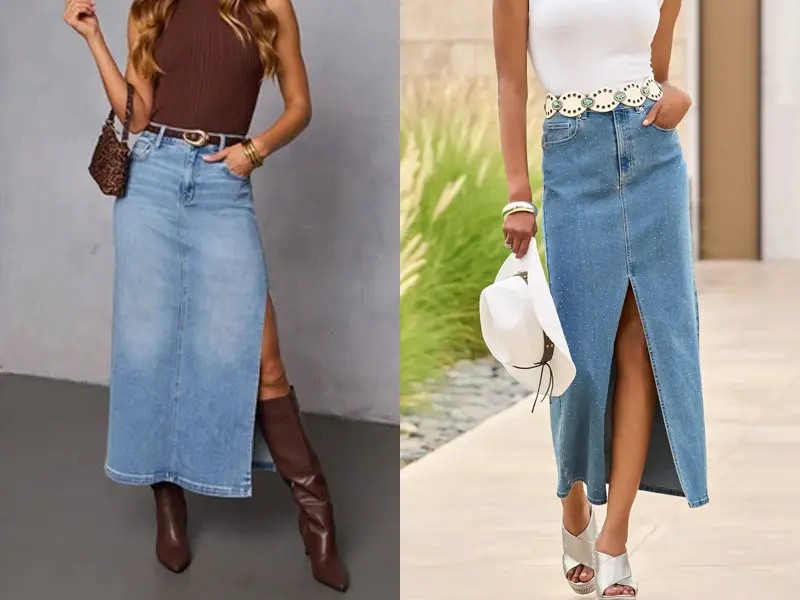
A front slit usually gives the most direct forward movement and creates a strong vertical focal line, while a side slit gives a more asymmetric look and releases movement from one side. Neither is automatically better. The right choice depends on skirt length, hem width, hip ease, denim weight, stretch and recovery, slit height, wash shrinkage, coverage expectations, and the visual character the collection needs.
The useful question, then, is not which slit is more fashionable in isolation. It is what the slit needs to do for the finished product. A structured front-slit midi developed for boots and a soft side-slit maxi made for summer may begin with similar reference images, but they need different pattern, fabric, wash, and movement decisions. That difference is where a simple styling comparison becomes practical product development – and where brands can avoid discovering a fit problem only after a sample has already been washed, photographed, or prepared for production.
What Is the Difference Between Front and Side Slit Denim Skirts?
A front slit opens along the front of the skirt and creates a strong vertical focal line, while a side slit opens along one side and produces a more asymmetric effect. Both can improve movement, but they release the garment in different directions. Their final performance depends on skirt width, slit height, denim stiffness, stretch, hip fit, panel balance, and how the fabric behaves after washing.
Front Slit Structure
A front slit is usually positioned at center front or slightly off center. On straight, column, and pencil denim skirts, it becomes part of both the visual design and the movement system. When the wearer steps forward, the two front sections separate naturally, reducing resistance from a narrow hem. That is particularly useful in rigid or low-stretch denim, where the fabric contributes little mechanical extension. Visually, the opening also breaks up a long block of denim, so a simple midi or maxi can feel lighter and more directional without adding extra decoration.
The trade-off is visibility. A front opening sits in the most photographed part of the garment, so small inconsistencies are easy to notice. If the center seam twists after washing, one side of the opening becomes longer, or the slit drifts off center, the whole skirt can look unbalanced even when most measurements are within tolerance. The slit therefore needs to be treated as part of the pattern architecture, with its seam line, upper termination point, reinforcement, hem relationship, and post-wash position defined before production rather than added as a late styling adjustment.
Side Slit Structure
A side slit normally follows or sits close to one side seam. It can be placed on the left, right, or both sides, depending on the product. Compared with a front opening, it is less dominant in the straight-on product view, which lets the center front remain clean for a fly, button placket, patch pockets, wash contrast, or decorative seam. During walking, the lower skirt releases mainly as one leg advances, creating a softer and often less obvious opening than a center-front split, especially when the denim has good drape.
Side slits are not automatically easier to develop. Their appearance depends heavily on side-seam balance. If the back needs more seat room, the seam can pull toward the rear; if the front panel carries too much length or width, it can rotate forward. The slit then appears misplaced even when its measured distance from the hem is correct. Pocket bags, utility panels, topstitching, and side-seam thickness can also affect the construction. For that reason, a side slit works best when waist shaping, high hip, full hip, front-to-back balance, and side-seam position are reviewed as one system.
Key Differences
The most reliable comparison is to look at the same design through consistent product variables rather than calling one option better. Front and side slits differ in visual emphasis, walking release, coverage behavior, pattern sensitivity, and the way construction errors become visible. The table below is a practical design-development reference. It is not a fixed rulebook: a soft A-line skirt and a rigid pencil skirt can behave very differently even when the slit length is identical, so fabric, silhouette, and intended use should always be considered together.

| Development Point | Front Slit | Side Slit |
| Visual emphasis | Strong center or near-center vertical line | Asymmetric, less dominant from front |
| Movement release | Direct forward stride | One-side stride release |
| Common silhouettes | Straight, pencil, column, midi, maxi | Straight, relaxed, A-line, midi, maxi |
| Main balance risk | Center-front twist or uneven opening | Side seam moving forward or backward |
| Coverage sensitivity | Often more visible when sitting | Often more visible during side movement |
| Key pattern control | Front-panel symmetry and seam alignment | Front/back balance and side-seam position |
| Photo impact | Highly visible in front-view imagery | More subtle in front-view imagery |
| Construction interaction | Center seam, fly, topstitch, reinforcement | Side seam, pockets, utility panels, reinforcement |
Which Slit Is Better for Movement and Coverage?
A front slit usually gives the most direct walking release on narrow straight or pencil skirts, while a side slit can provide comfortable movement with less obvious frontal exposure. Coverage depends more on slit length, hem circumference, hip ease, fabric stiffness, and sitting posture than on position alone. The best choice should be tested while walking, stepping, and sitting rather than judged only on a mannequin.
Walking and Stride
A slit partly exists because long or close-fitting skirts limit the distance the legs can separate. With rigid denim, that restriction is more noticeable because the cloth does not stretch much to absorb a longer step. Once the hem circumference becomes the limiting factor, the wearer starts shortening her stride, lifting the skirt slightly, or forcing the opening apart. A front slit addresses this directly because it opens in the same general direction as the forward leg. On a pencil midi or narrow column maxi, that makes the movement benefit easy to feel during the first fitting.
A side slit releases the garment differently. One side of the lower skirt can move away from the leg while the opposite side stays comparatively closed. This can feel natural on softer midi and maxi skirts with a little more sweep, but it cannot compensate for a pattern that is too tight through the hip or thigh. A practical fit test should therefore include more than a few steps in front of a mirror. Walking ten to fifteen normal steps, taking a longer stride, stepping onto a low platform, and sitting down will show whether the slit is genuinely improving mobility or simply hiding insufficient ease elsewhere in the skirt.

Sitting and Coverage
Coverage often changes more during sitting than standing. A front slit can look controlled when the wearer is upright, then open much farther as the knees bend, the thighs separate, and the skirt shifts upward. A side slit may stay less visible from the front but reveal more of the outer thigh when the wearer crosses her legs, gets into a vehicle, or takes a wide step. That is why ‘front is more revealing’ or ‘side is more modest’ is too simple for serious product development.
The better approach is to define coverage as a product requirement. A work-friendly midi, a festival skirt, and an evening maxi can intentionally use different exposure levels. Skirt length, slit length, thigh ease, chair height, and even the intended footwear affect the result. During sampling, the team should review front, side, and seated views and record the opening behavior rather than relying only on a flat measurement. If the slit must be raised simply to make walking possible, increasing hem sweep by a few centimeters may give a better balance between mobility and coverage than continuing to lengthen the opening.
Slit Height
Slit height should be specified from a stable point, normally the finished hem to the top of the opening. Descriptions such as ‘high slit’ or ‘medium slit’ are useful for mood boards but too vague for production. The same 30 cm opening can look aggressive on a short skirt and modest on a long maxi, so the number only has meaning when it is read together with total skirt length, hem sweep, and body coverage. Grading should also be reviewed rather than blindly adding or subtracting the same amount in every size.
A useful development check is to ask what function the slit is serving at its current height. If it is mainly decorative, the opening can be positioned for visual proportion and styling. If it is required for movement, the team should test whether the hem is too narrow before making the slit higher. If coverage is the priority, the top of the opening should be reviewed in normal walking and seated positions. The goal is not to hit an industry-wide number; it is to create a repeatable measurement that supports the intended silhouette, target customer, and real-life movement of that specific skirt.
How Does Slit Placement Change Fit and Silhouette?
Slit placement changes both the visual balance of a denim skirt and the path that tension follows through the garment. A front slit emphasizes length and front-panel symmetry, while a side slit shifts attention toward the outer leg and makes side-seam balance more important. Poor waist, hip, or seat fit can cause either opening to spread, twist, flare, or move away from its intended position.
Front Visual Balance
Front-slit skirts are visually unforgiving because people instinctively notice whether a center line is actually centered. On a clean midi or maxi with limited decoration, the seam and opening can become the strongest vertical reference on the garment. If the slit drifts a little after washing, the product may look twisted even when individual sewing measurements seem acceptable. This is especially important for ecommerce imagery, where the main front view can magnify small alignment problems that may be less obvious while the garment is moving in real life.
The pattern therefore needs a clear relationship between waist, front panel, hip line, center seam, slit, and hem. The grain direction also matters because skew can rotate the seam after washing. A front opening can create an elegant lengthening effect when everything is balanced, but that same strong vertical line can expose poor cutting, uneven seam allowance, asymmetric shrinkage, or inconsistent reinforcement. Approving the raw garment is not enough. The washed fitting should confirm that the opening remains centered, both sides finish at the same length, and the hem still sits level when the wearer stands naturally.
Side Seam Balance
A side slit often reveals fit problems that began much higher in the garment. If the side seam moves toward the front, the first instinct may be to blame sewing accuracy, yet the actual cause can be too much front width, insufficient seat room, incorrect hip shaping, or an imbalance between front and back length. Because the opening gives the lower side seam a very visible endpoint, even a gradual rotation can make the slit look as though it was deliberately placed in the wrong position.
During fitting, the side seam should be treated as a diagnostic line rather than just a construction seam. It should fall close to vertically through the body unless the design intentionally moves it. Product teams should review waist shaping, high hip, full hip, seat ease, front and back length, and hem level before changing the slit itself. When those upstream issues are corrected, the opening often settles into place without major adjustment. This is one reason experienced pattern work matters on fashion denim: the visible defect may be at the slit, while the real pattern problem can sit twenty or thirty centimeters above it.
Hip Ease and Opening
A common mistake is to use the slit as a release valve for a skirt that is too tight through the hips or thighs. Excess horizontal tension travels toward the open area. On a front slit, the top can form an unwanted inverted V while the wearer is simply standing. On a side slit, the opening may flare away from the leg or the seam may pull diagonally. Increasing reinforcement can stop tearing, but it does not solve the fit problem that is forcing the opening apart.
Rigid denim makes this relationship especially visible because the fabric cannot stretch enough to hide poor ease. Stretch denim can feel more forgiving at first, but weak recovery may create a different problem: the hip, seat, and slit area can grow during wear and lose the clean shape seen in the fitting room. That is why stretch and recovery should be considered together, and why the same pattern block should not be used unchanged for rigid and stretch fabrics. The best result comes from balancing waist-to-hip shaping, garment ease, fabric behavior, and slit function instead of trying to correct one variable in isolation.
Which Slit Works Best for Different Denim Skirts?
Front slits tend to work best on narrow straight, pencil, and column skirts where the opening directly supports stride and a strong vertical line suits the design. Side slits work well on straight, relaxed, and longer skirts when the front should stay cleaner or the look needs softer asymmetry. A-line skirts usually need less functional slit depth because the wider hem already provides more movement.
Midi Skirts
Midi skirts make slit decisions especially noticeable because the hem often falls below the knee, exactly where a narrow circumference starts to influence stride. A front slit works naturally on straight and pencil midis because it gives direct movement while visually breaking up the front panel. It can also show more of the footwear, which is useful when a collection is styled with boots or heels. A side slit becomes attractive when the center front already carries a button placket, fly, patch pocket, contrast panel, or wash effect that the designer wants to keep uninterrupted.
Fabric can tip the decision. A soft 8-9 oz denim may move easily with a modest side opening, while a structured 11-12 oz straight midi usually needs more deliberate movement engineering. Those ounce ranges are practical working windows rather than universal rules, because fiber content, weave, finishing, and stretch can make two fabrics with the same nominal weight behave very differently. The key is to test the actual washed fabric in the intended silhouette. A midi that feels fluid on the cutting table can become noticeably firmer after certain finishes, while another fabric may soften enough that a previously necessary slit height can be reduced.
Maxi Skirts
Maxi skirts amplify construction choices because the panels are longer and carry more fabric. Small amounts of skew, uneven shrinkage, or side-seam movement are easier to notice over a 90-100 cm garment length than on a short skirt. Narrow column maxis often benefit from a front slit because the opening gives predictable forward release. Softer maxis can work beautifully with a side slit, especially when the front design is intended to stay clean and the collection calls for a less graphic leg reveal.
Double side slits are another option, but they create two openings that need to finish at matching heights and react similarly after washing. Long skirts also need careful hem stability because a small twist can make one side appear longer or cause the opening to sit unevenly. For this reason, a maxi should not be approved only in raw denim. The washed sample is the more meaningful reference, and it should be checked for total length, slit length, seam alignment, hem level, and walking behavior. A long skirt can look impressive in a still photograph while feeling awkward as soon as the wearer takes a full stride.
Pencil and A-Line Skirts
Pencil skirts create the strongest functional need for a slit because the silhouette deliberately limits circumference around the knees and lower thighs. A front slit is efficient because it opens in the direction of travel, while a side slit offers similar relief with a cleaner center front. In both cases, the skirt still needs enough seat and thigh ease. The best sample is not the tightest sample; it is the one that holds the intended shape while allowing normal walking and sitting without forcing the opening apart.
A-line skirts are different because the hem already widens as it falls from the hip. The slit can therefore become more decorative than mechanical. A front opening can sharpen a classic A-line and create a strong focal line, while a side opening can blend naturally with utility pockets or asymmetric panels. Because the hem has more sweep, the opening often does not need to be as high as it would on a narrow skirt of the same length. The table below offers useful development windows, but the actual fabric and washed sample should always decide the final choice.
| Skirt Type | Typical Slit Choice | Useful Denim Window | Main Development Concern |
| Pencil midi | Front or side | 9-11.5 oz | Walking ease and hip tension |
| Straight midi | Front or side | 8.5-11.5 oz | Slit height and coverage |
| Column maxi | Front | 9-12 oz | Stride and center balance |
| Relaxed maxi | Side | 8-10.5 oz | Drape and side-seam stability |
| A-line midi | Optional front or side | 8-11 oz | Visual balance more than mobility |
| A-line maxi | Low side or decorative front | 8-10.5 oz | Hem sweep and wash stability |
How Do Denim Fabric and Wash Affect a Slit?
Denim weight, composition, stretch, and wash can change slit behavior as much as the pattern itself. Rigid denim keeps a defined opening but needs more pattern ease; stretch denim improves mobility but depends on recovery; lightweight denim drapes more softly but is more sensitive to puckering. Washing can alter shrinkage, skew, handfeel, seam alignment, and opening shape, so final approval should use the intended wash.
Rigid vs Stretch
Rigid and stretch denim distribute movement in different ways. Rigid fabric relies mainly on garment shape, so the pattern and slit must provide the room that the wearer needs. This makes slit geometry particularly important on narrow midis and maxis. The fabric also tends to hold the opening more clearly, which can create a crisp, structured look but can concentrate stress at the top of the slit when the wearer takes a longer step or sits down in a close-fitting skirt.
Stretch denim shares part of the movement load with the fabric, which can make fitted skirts more comfortable with a smaller opening. The important word is recovery. A fabric can stretch easily in a hand test but still perform poorly if it does not return to its original dimensions. Weak recovery can lead to growth through the hip and seat, a wavy side seam, or a slit that no longer closes neatly after several hours of wear. Product teams should therefore evaluate stretch and recovery together and develop the pattern around the actual fabric rather than using a rigid block and simply substituting a stretch construction.
Fabric Weight
Weight influences drape, seam bulk, movement resistance, and the way the opening falls. In JEANZIO’s common denim-apparel development range, roughly 8-13 oz covers many skirt applications, with lighter fabrics typically offering more drape and heavier fabrics giving stronger shape. An 8-9 oz skirt can move softly and may need less slit depth, while a 12-13 oz rigid skirt can feel much more architectural and may place greater stress on the opening during a long stride. The same nominal weight, however, does not guarantee the same behavior.
Composition and finishing can completely change the result. A 10 oz cotton-rich rigid fabric may feel firmer than another 10 oz fabric with a softer fiber blend or comfort stretch. Enzyme washing, softener, resin, coating, or heavy mechanical abrasion can also change stiffness and handfeel after the sample leaves the sewing room. That is why a fabric specification should include more than ounce weight. Composition, stretch category, recovery, shrinkage, surface finish, and target wash are all relevant to slit performance. The table below is best used as a starting point for development, not as a substitute for testing the actual washed material.
| Denim Weight | Typical Behavior | Slit Implication |
| 8-9 oz | Light, soft, higher drape | Smaller openings may provide enough movement; watch seam puckering |
| 9-10.5 oz | Balanced comfort and structure | Versatile for midi and relaxed maxi skirts |
| 10.5-12 oz | More structured and resistant | Narrow silhouettes need deliberate stride planning |
| 12-13 oz | Firm, strong visual shape | Slit stress, seam bulk, and mobility become more important |
Wash and Alignment
Washing can change almost every dimension around a slit. Shrinkage may reduce total skirt length and the finished opening; skew can rotate a center or side seam; enzyme or softener can make the panels drape farther apart; aggressive abrasion can reduce strength around the upper termination point. A skirt can match the approved shade and still fail because the slit has twisted or the hem has become uneven, so appearance and dimensional stability should be checked separately.
A practical after-wash review should record total length, slit length, hem width, waist, hip, seam alignment, and visible twist. The longer the skirt, the more noticeable a small angular change becomes. Bulk consistency also depends on fabric-lot control and cutting direction because different lots can react differently in wash. At JEANZIO, slit-related quality is treated inside a broader control route that links fabric input, cutting, inline sewing, pre-wash checks, post-wash review, finished-garment inspection, and final acceptance. That sequence is more reliable than trying to catch a twisted opening only at the packing table.

How Should Brands Develop a Denim Skirt Slit?
A denim skirt slit should be developed as a measurable construction feature, not a visual note on a sketch. The process should define slit position, finished length, silhouette, fabric, wash, reinforcement, and coverage expectations, then verify them through pattern work, first sample, movement fitting, after-wash measurement, and PP approval. Bulk production should follow the same approved pattern, wash reference, workmanship standard, and measurement specification.
Tech Pack Details
A useful tech pack makes the slit difficult to misinterpret. ‘Front slit’ alone is not enough because the factory still has to decide the exact location, finished length, seam allowance, opening finish, stitch appearance, and reinforcement. The drawing should show whether the opening is center front, offset, left side, right side, or double side. The measurement chart should define the distance from the finished hem to the top of the slit, and the same document should identify total skirt length, hem sweep, waist, high hip, full hip, fabric, stretch category, and target wash.
The slit should also be linked to tolerances and the correct stage of measurement. A raw-garment opening and an after-wash opening may not finish at the same length, so the specification needs to make clear which condition controls approval. If the brand begins with a reference image rather than a complete technical package, missing information should be turned into explicit development decisions instead of assumptions. A capable development team can help define the pattern, material, wash, construction, and measurement route, but the final approved standard still needs to be written down so the production floor is working from something more reliable than visual memory.
Movement Testing
A slit sample should be tested as a moving garment. The fit model should stand naturally for front, side, and back balance, then walk ten to fifteen normal steps, take a longer stride, step onto a low platform, sit on a normal chair, and stand again. These simple actions reveal whether the opening spreads while standing, rises too far during walking, pulls at the top, or causes the skirt to shift out of position. They also show whether a problem belongs to the slit itself or to insufficient ease through the hip, seat, or thigh.
The same review should be repeated after the intended wash because denim behavior can change significantly through finishing. A raw rigid skirt may feel controlled and slightly stiff, while the washed garment can soften enough to open more freely. Measurements before and after wash help the team separate pattern issues from shrinkage or skew. For a new JEANZIO development, it is often more productive to treat each sample round as a technical question – fit, movement, wash, or workmanship – rather than chasing speed alone. A sample that arrives quickly but does not resolve the key decision can still delay the total product calendar.
Reinforcement and Bulk Control
The top of the slit is a stress concentration point. During a long step, sitting movement, or repeated wear, force is transferred to the location where the closed seam becomes open. Reinforcement therefore needs to match the fabric and visual character of the product. A visible bartack may suit workwear-inspired denim, while a cleaner fashion skirt may use reinforced stitching or a construction that spreads stress more discreetly. There is no reason to apply the same reinforcement method to every denim skirt if the material thickness, seam type, and design language are different.
Bulk consistency depends on freezing the approved references before cutting starts. The production team should work from the same pattern version, measurement chart, fabric standard, wash reference, trim specification, and PP sample. At JEANZIO, quality control connects incoming fabric, cutting, inline sewing, pre-wash, post-wash, 100% finished-garment inspection, and an AQL 2.5 or customer-defined final audit where applicable. For a slit skirt, the key checkpoints include opening length, seam position, reinforcement, after-wash twist, hem level, and movement function. A successful sample proves the design can be made once; disciplined bulk control proves it can be reproduced across the order.
Conclusion
Front slit and side slit denim skirts can both be strong commercial products because they solve different design problems. A front opening is usually the clearer choice when a narrow silhouette needs direct forward movement and the collection benefits from a strong vertical focal line. A side opening is often more suitable when the center front should remain clean, the design needs softer asymmetry, or the fabric already provides enough movement that the slit can play a more visual role. The final decision should come from the complete product – skirt length, hem width, hip ease, fabric weight, stretch, wash, coverage, and real movement – rather than from a trend image alone. For brands developing a new style with JEANZIO, sharing the reference image, target fit, finished length, wash direction, expected fabric character, size range, and order plan at the start makes it easier to evaluate the slit as part of the whole garment and reduce avoidable changes later in sampling or bulk production.
Frequently Asked Questions
Is a front slit or side slit better for a denim midi skirt?
Both can work well, but the silhouette usually decides the better option. A narrow straight or pencil midi often benefits from a front slit because it releases the garment directly during forward walking. A side slit is useful when the center front carries important design details or the brand wants a less obvious leg reveal. Fabric stiffness, hem sweep, slit height, and sitting coverage should be tested before the final choice is approved.
How high should a slit be on a denim skirt?
There is no universal ideal height because a slit must be judged relative to total skirt length, hem circumference, body coverage, and intended movement. The practical production method is to specify the finished distance from the hem to the top of the opening and test it while walking and sitting. If a slit has to be raised simply to make the skirt wearable, the pattern may need additional hem sweep rather than a taller opening.
Does a front slit make a denim skirt easier to walk in?
It often does, especially on narrow straight, pencil, and column skirts. A front slit opens in the same general direction as the wearer’s stride, so it gives direct release where the legs separate. The benefit is most noticeable in rigid or low-stretch denim. However, the slit cannot compensate for insufficient hip, seat, or thigh ease, so movement should be reviewed across the full pattern instead of treating the opening as the only mobility solution.
Is a side slit more modest than a front slit?
Not necessarily. A side slit can appear less revealing from a straight front view, but it may expose more outer thigh during a long step, when getting into a car, or when crossing the legs. A front slit may look controlled while standing and open more when sitting. Modesty therefore depends on slit length, skirt length, hem width, fit, and posture rather than placement alone. Sampling should include seated and moving views, not only standing photographs.
What denim weight works well for slit skirts?
Many denim skirts can be developed within roughly an 8-13 oz working range, but the best weight depends on silhouette and intended handfeel. Lighter 8-9 oz fabrics suit softer, drapier skirts, while 10.5-12 oz fabrics create more structure and resistance. A 12-13 oz rigid fabric can produce a strong architectural look but requires careful movement planning. Composition, stretch, recovery, and wash finishing matter as much as ounce weight.
Can washing change the position of a denim skirt slit?
Yes. Denim washing can change shrinkage, skew, handfeel, seam alignment, and overall garment balance. A front slit may drift away from the visual center, while a side slit can rotate toward the front or back if the fabric or pattern twists. The final approval should therefore use the intended washed sample and include total length, slit length, hem level, seam position, and visible twist. Bulk production should also keep fabric lots and wash standards controlled.
What should a tech pack include for a slit denim skirt?
A production-ready tech pack should show slit location, finished slit length, total skirt length, hem sweep, waist and hip measurements, seam allowance, stitch and topstitch details, reinforcement, hem construction, fabric weight and composition, stretch category, wash reference, and after-wash tolerance. If the style starts from a reference image, these missing fields should be resolved during development and then frozen in the approved specification before bulk cutting begins.